← Back to Blogs
Amazon Ads
12 min read
Why Your Amazon PPC Budget Goes To The Loudest Keyword, Not The Profitable One

Onieque Edwards
Content Strategist /Blog Writer

Why Your Amazon PPC Budget Goes To The Loudest Keyword, Not The Profitable One
Most Amazon accounts get worked at the bid level, because the bid is the layer with a box you can type a number into. Raise it, lower it, harvest, negate, repeat. It feels like the work.
It is often the wrong layer. Not because bids do not matter, but because a bid can only decide what you pay for a click inside a structure that has already decided which clicks you are buying at all.
The version of this that costs the most money looks like a healthy account. Dozens of campaigns, all running, nothing obviously broken, spend arriving every day. And a report that cannot answer the only question worth asking, which is which of these terms is actually making money.
That is a structure problem. It does not respond to bids, and it will absorb as much bid management as you can afford to throw at it.
What a campaign actually is
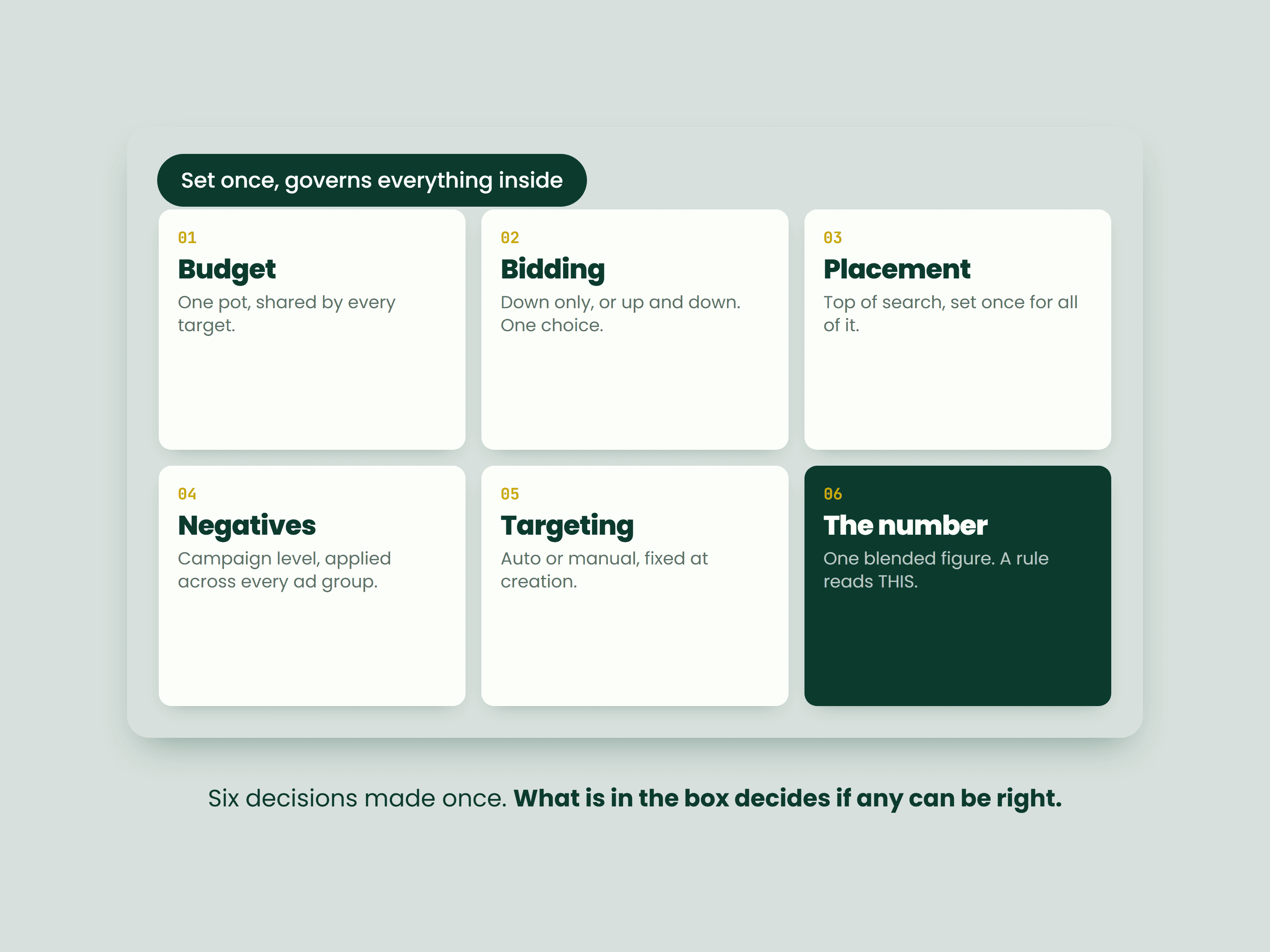
Not a folder. The campaign is the unit where several decisions get made once and then govern everything underneath them.
At the campaign level, and nowhere below it:
The daily budget. One pot, shared by every ad group and every target inside it.
The bidding strategy. Down only, up and down, or fixed. One choice for the whole campaign.
Placement bid adjustments. Top of search, product pages, rest of search. Set once, applied to everything inside.
Campaign-level negative keywords, which apply across every ad group in it.
The targeting type, auto or manual, fixed at creation and not changeable afterwards.
The number a budget rule reads, which is the whole campaign blended into one figure.
That list is why a campaign is a strategic object rather than an organisational one. Six decisions apply to everything inside the container, so what you choose to put in the container decides whether those six decisions can be made well.
Put one job in it and each of the six has an obvious right answer. Put three jobs in it and every one of the six becomes a compromise between goals that want opposite things.
The three jobs, and why they cannot share a budget
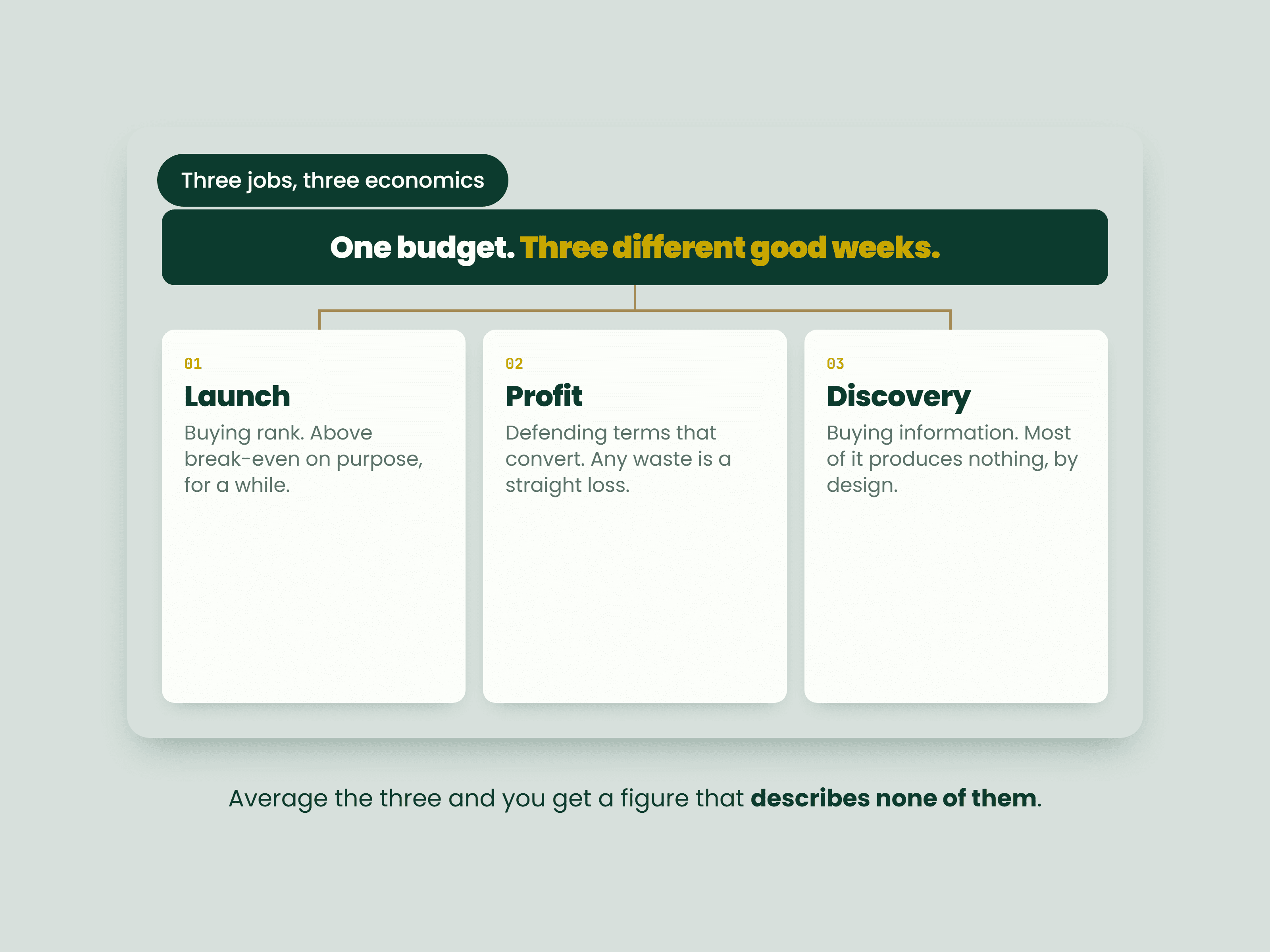
Almost all Sponsored Products spend is doing one of three jobs, and they are genuinely different work with different economics.
Launch. Buying rank and early sales velocity on a product that has no history. A high ACoS here is not a failure, it is the price of the position, and it is supposed to come down later. The measure of success is rank movement and review accumulation, not efficiency this month.
Profit. Defending terms you already convert on, at an ACoS comfortably under your margin. Efficiency is the entire point. Any spend here that does not clear the break-even line is a straight loss, because there is no future position being bought.
Discovery. Buying information. Broad, auto and loose targeting exists to find out what shoppers actually type. The output is a search term report, not a sale, and the correct expectation is that most of the spend produces nothing useful and a small slice produces something valuable.
Three jobs, three acceptable ACoS figures, three different definitions of a good week.
Now put all three in one campaign with one budget. The budget cannot be sized, because the right number for a launch is not the right number for a defended term. The bidding strategy cannot be chosen, because down-only protects the profit job and starves the launch. Placement adjustments cannot be set, because top of search is where a launch wants to be and often where a discovery campaign wastes the most. And the number the campaign reports is a blend of a deliberately unprofitable launch, a deliberately profitable defence and a deliberately speculative test.
That blended number is not a slightly worse number. It is a number that cannot be acted on at all, because a good result and a bad result in it look identical from outside.
Amazon says do not mix them, and the reason it gives is measurement
This is not agency opinion. Amazon's guide to targeting with Sponsored Products says plainly: "We recommend that you avoid mixing different targeting strategies within the same campaign and ad group."
The reason the page gives is the part worth reading twice. It frames it as keeping your approach aligned with how you measure success — awareness tactics are judged on impressions and click-through rate, conversion tactics on sales. Same page, same logic: create separate campaigns or ad groups when you are optimising for different metrics.
So the documented argument for separating campaigns is not tidiness and not control. It is that a campaign is a measuring instrument, and an instrument pointed at two different questions returns an answer to neither.
Worth keeping straight, because it gets confused constantly: the thing to separate is intent, not syntax. The same page says testing broad, phrase and exact on one keyword is fine, because "you won't be bidding against yourself by adding different match types on the same keyword". Match types together are documented as acceptable. Targeting strategies together are documented as something to avoid.
What actually happens to a shared budget, and what does not
Here is the mechanism, in Amazon's own words. From its Sponsored Products budget guide: "Daily budgets are spent as quickly as possible, because all available impressions for your ads to show to relevant shoppers are taken."
Read that against a shared pot. The budget is not divided between the jobs in that campaign, and it is not allocated by which job is doing best. It is consumed as fast as impressions become available.
Which means the target that generates volume fastest takes the money first. Not the target with the best conversion rate. Not the one clearing your margin. The one with the most search demand behind it, because that is where the impressions are.
That is the honest version of the thing everyone half-knows. The budget does drift toward the loudest signal, and the reason is not an algorithm choosing for you. It is a shared pot and a queue.
And it is worth being precise about what Amazon does not do here, because the folklore in the other direction is expensive too. Sponsored Products does not automatically move budget between your campaigns. Amazon's own budget rules documentation describes two rule types, schedule-based and performance-based, and every example is one campaign changing its own budget. Nothing on that page describes money moving from Campaign A to Campaign B. The genuine automated reallocation people have read about belongs to Amazon DSP, which has orders and line items rather than campaigns and ad groups, and is a different product in a different console.
So the risk runs both ways. Inside one campaign, money flows to volume whether you meant it to or not. Between campaigns, nothing flows at all, and an account run on the belief that Amazon is rebalancing for you will never be corrected by a dashboard, because a false sense of automation does not show up as an error.
*(The budget mechanics themselves are covered in more depth in one campaign is spending all your money. This piece is about what those mechanics mean for what belongs in a campaign in the first place.)*
The budget ceiling is not the ceiling most people think it is
If you are going to give each campaign its own budget ceiling, it is worth knowing exactly what a ceiling does, because the number in the box is not a hard daily cap.
Amazon's budget guidance states that a daily budget carries built-in flexibility: you can spend up to 25% more than your average daily budget on any given day, with the monthly total still landing where the average implies. A $10 daily budget can spend $12.50 on a busy day and less on a quiet one.
Two consequences that matter when you are setting ceilings deliberately.
A ceiling is a monthly instrument, not a daily one. If your reason for capping a discovery campaign is that you do not want to spend more than a set amount on information this month, the average is the number that governs, and any single day can run over it.
"Out of budget" is a status, not a warning. Amazon defines it as a campaign having used the allocated daily budget because ads were served. It is not an error, it does not email you, and on a launch campaign it means the position you are paying to build stops being built partway through the day, every day, at whatever hour the money runs out.
Both of those are only readable when a campaign has one job. On a mixed campaign, "out of budget" tells you the pot emptied and nothing about which of the three jobs emptied it.
What separating the jobs actually buys you
Not efficiency directly. Structure does not lower a single bid or remove a single wasted click on its own. What it produces is a set of numbers that can be acted on, and the actions follow from that.
A budget you can size. Once a campaign has one job, the right budget is a question with an answer. A discovery campaign is capped at what you are willing to pay for information this month. A defended-term campaign is sized to demand, because every efficient sale in it is worth having. A launch campaign is sized to the position being bought and given an end date.
A bidding strategy you can choose. Down-only on the profit campaigns protects margin. Up-and-down on a launch buys the placement it needs. Those are opposite settings and one campaign can only hold one of them.
Placement adjustments that mean something. Top of search costs a premium and converts differently by job. A launch usually wants it. A discovery campaign usually does not, and that adjustment is often where a large share of avoidable spend sits.
A search term report you can read. This is the one that changes how the account gets managed. When a term's spend sits inside a single-job campaign, its number means something specific: this term cost this much while doing this job. Blended across three jobs, the same term's line is uninterpretable, and the usual response is to negate on gut feel or leave it alone. Both are guesses.
A budget rule that reads a real number. Performance-based rules act on a campaign's own metric. On a single-job campaign that metric is a fact about that job. On a mixed campaign the rule is acting on an average of three things that were never meant to be averaged.
What restructuring does not fix, and this part is not optional
A rebuild is a real intervention with real costs, and it is oversold constantly. Four things it does not do.
It does not fix a listing that does not convert. If the traffic arrives and does not buy, better-organised campaigns buy the same lost sale in a tidier way. Conversion is upstream of everything here.
It does not create demand. Separating a discovery campaign out does not make people search for your product more. It makes what they do search legible.
It does not survive going out of stock. A product that loses the Featured Offer stops serving ads entirely, whatever the structure looks like.
It costs you campaign history. New campaigns start without performance history, and there is a settling period while they gather data. This is the real argument against restructuring on impulse, and it is why the answer to "should I rebuild" is not automatically yes.
Which is why the honest sequence is: work out what is actually capping the account first, and only rebuild if the answer is that you cannot see. A rebuild is the right move when the problem is that the numbers are unreadable. It is the wrong move when the numbers are readable and simply bad.
How to separate without throwing the history away
If the diagnosis does hold, the way to do it costs less than a clean-slate rebuild.
Do not delete anything. Build the new structure alongside the old and move budget across gradually rather than switching in one day. The old campaigns keep running while the new ones gather history, and you keep the option to stop.
Move the proven terms first. The terms you already know convert are the ones with the clearest job, so they are the safest to lift into a dedicated campaign. Speculative and broad targeting is the last thing to move, because it is the part whose history is worth the least.
Take one product line at a time. A whole-account rebuild in one week removes your ability to tell what caused any change that follows. Sequenced by line, each move has a before and an after that can be read.
Write down the job before creating the campaign. If you cannot say in one sentence what a campaign is for and what number would tell you it is working, it will end up carrying a second job within a month. That sentence is the thing that keeps the structure intact after it is built, and it is the step that gets skipped.
The decision underneath all of this
Structure is not an organisational preference and it is not a tidiness exercise. It is where you decide, in advance, what your money is allowed to be spent on and what each pound of it is supposed to buy.
A campaign carrying three jobs has made that decision by default, and the default is that whatever has the most search volume behind it takes the budget first, every day, until the pot is empty. That is not a bidding outcome. No bid change reverses it, because the bid only operates on clicks the structure already agreed to buy.
The question is not how many campaigns you should have. It is what number each one is supposed to produce, and whether you could act on that number if you read it tomorrow morning.
If you cannot answer that for a campaign, more bid management will not help. The account is not being managed. It is being tended.
If your spend is arriving every day and the report still cannot tell you which terms are making money, that is what the audit does.
FAQ
How many campaigns should I have on Amazon?
There is no correct count, and any number quoted without knowing your catalogue is guesswork. The useful test is a question rather than a number: for each campaign, can you say in one sentence what job it does and what figure would tell you it is working? Every campaign that fails that test is either doing more than one job or has no job, and both show up the same way, as spend you cannot attribute to a decision.
Should launch campaigns and profit campaigns be separate?
Yes, and the reason is that they define success differently. A launch is buying rank and accepts an ACoS above break-even for a period, on purpose. A profit campaign is defending terms that already convert and treats any spend above break-even as a loss. Sharing a budget means one of the two is always being judged by the wrong standard, and sharing a bidding strategy means one of them is on the wrong setting.
Why did my Amazon ads stop showing in the afternoon?
Most often the campaign hit out of budget. Amazon defines that as the campaign having used its allocated daily budget because ads were served, and it states that daily budgets are spent as quickly as impressions are available. On a shared campaign the money usually went to whichever target had the most search demand behind it, which is not necessarily the one you would have chosen to fund.
Does Amazon move my budget between campaigns automatically?
Not in Sponsored Products. Amazon's budget rules documentation describes schedule-based and performance-based rules, and every example is one campaign changing its own budget. The automated reallocation people have read about belongs to Amazon DSP, which is a separate product. Running an account on the assumption that rebalancing is happening for you is a quiet way to leave money in the wrong place, because there is no error message for it.
Will restructuring my campaigns lose my performance history?
New campaigns do start without history and need a settling period before their numbers mean much, which is a genuine cost and the main reason not to rebuild casually. It is reduced by building alongside the existing structure rather than replacing it, moving proven terms first, and sequencing by product line so each move has a readable before and after.
Is campaign structure or bid management more important?
They operate at different layers and the order matters. A bid decides what you pay for a click; the structure decides which clicks are available to buy and whether the resulting numbers can be interpreted. Bid work inside an unreadable structure produces changes you cannot evaluate, so structure comes first when the problem is that you cannot see, and bid work comes first when you can see clearly and the numbers are simply wrong.
SOURCES
Onieque Edwards
Content Strategist /Blog Writer
Onieque is the brain behind bold Amazon growth strategies and structured business execution. He enjoys turning scattered ideas into clear, actionable systems that actually drive results. When he’s not building out growth plans or refining campaigns, you’ll likely find him exploring new coffee spots or getting lost in ideas that connect strategy with creativity.