← Back to Blogs
Amazon Ads
16 min read
One Campaign Is Spending All Your Money: Sponsored Products Budget Only Exists At The Campaign Level

Onieque Edwards
Content Strategist /Blog Writer

One Campaign Is Spending All Your Money: Sponsored Products Budget Only Exists At The Campaign Level
Open Campaign Manager on a Monday and one campaign has eaten the week. The instinct is to go and find the product that did it, give that product its own budget, and get on with the day.
There is no field for it. That absence is the whole article.
Can I set a budget for one product only? Not in Sponsored Products
In Sponsored Products the daily budget is a field on the campaign. Not on the ad group, not on the keyword, not on the ASIN. Amazon's own budget guide describes the campaign daily budget as "the maximum amount you will spend on running your ad campaign", and everything you place inside that campaign draws from it. Open a bulk sheet and look for an ad group budget column. It is not there either.
The operator phrase for this is campaign-level budget, and it means exactly what it says. The campaign is the only object in Sponsored Products that holds money. An ad group is a container for targeting, not a container for spend.
One dated mechanic to get straight before anything else, because it changes what the number even means. Your daily budget is averaged over the calendar month rather than enforced as a hard daily ceiling. Amazon's budget guide describes spending "up to 25% more than your average daily budget on any given day", and on 9 May 2023 Amazon Ads published a change to that policy raising the ceiling to up to 100% more on a given day, with the 25% and 100% options selectable in the Settings tab or through the average daily budget API. So the number you typed is a monthly average with a documented overage band, and which band you are on is a setting somebody chose.
Why that matters here: whatever you group into one campaign is now a single financial object, whether or not it is a single strategic object. You did not decide how to organise your account. You decided what is forced to share money.
Why did my ads stop showing? Out of budget is a status, not a warning
The symptom most sellers arrive with is ads that ran in the morning and stopped by lunch. In Campaign Manager that shows as an out of budget status, and it means the campaign spent its daily budget and became ineligible to serve until the reset. Amazon does not queue your remaining hours for you or hold anything back for the afternoon.
That is a timing problem and it has its own piece, so I will not rebuild it here. Read budget-spent-in-arrival-order for what an exhausted budget costs by hour and what the two obvious fixes fail to fix. The part that belongs to this article is narrower and it is the part almost nobody checks: when a campaign runs out of budget, it did not run out on behalf of one product. It ran out on behalf of everything inside it.
One campaign is spending all your money because every ad group shares one pot
Put branded defence, competitor conquest and complementary product targeting into one campaign and you have created a shared campaign budget pool. Three intentions, three acceptable costs, one wallet, and no mechanism inside Amazon that rations between them by intent.
Nothing in the interface tells you this is happening. There is no split of spend by strategic purpose on the campaign screen, because Amazon has no idea which of your ad groups you consider defence and which you consider acquisition. It sees one campaign spending one budget.
Sellers describe the result long before they can name it. One listing never seems to get ad traffic. Another one eats the month. The account looks like it is making choices, and it is, on a rule nobody set.
Should I put all my keywords in one campaign? Amazon's own targeting guide says do not mix strategies
Worth quoting directly, because this one gets asserted constantly by people who could have checked. Amazon's guide to targeting with Sponsored Products says to "avoid mixing different targeting strategies within the same campaign and ad group".
The same page also kills a piece of folklore going the other way. Testing broad, phrase and exact on the same keyword in the same structure is fine by Amazon's own account, because "you won't be bidding against yourself by adding different match types on the same keyword". So match types together are documented as acceptable. Targeting strategies together are documented as something to avoid.
That distinction is the useful one to carry out of this section. The thing to separate is intent, not syntax.
Can Amazon move my budget around automatically? Two 2026 posts ten days apart say opposite things
Here is the live one, and it is dated.
On 5 May 2026, sellermetrics.app published a budget rules update claiming "dynamic budget allocation", described as Amazon now redistributing funds across campaigns it believes will perform better, plus a daily budget extension of up to 25% "when the system detects high purchase intent". I read it looking for the citation. There is no Amazon announcement, no help page, no data source behind either claim. It links to Amazon's budget rules guide generically and quotes nothing from it that supports cross-campaign redistribution.
On 15 May 2026, ten days later, off-hours.app published the opposite sentence: "Amazon's native rules cannot decrease budgets, pause campaigns based on time, or reallocate budget between campaigns."
The tiebreaker is Amazon's own complete guide to budget rules. It documents two rule types. Schedule-based, which raises or lowers a campaign's budget across a date range. Performance-based, which raises a campaign's budget when that same campaign crosses a threshold you name, such as ROAS, CTR or CVR. Every example on the page is one campaign changing its own budget. The page never describes money moving from Campaign A to Campaign B, and a feature guide that omits the headline capability of the feature is telling you something.
My verdict for this piece: cross-campaign automatic reallocation in Sponsored Products is unverified and reads as false. If you are running your account on the belief that Amazon is rebalancing between campaigns for you, there is no dashboard that will correct you, because the failure mode is a false sense of automation rather than a visible error.
Two boundaries around that verdict, both of which matter.
The narrow beta that does exist. A shared unspent budget feature at the portfolio level was reported on 21 January 2025 by JumpFly, citing an Amazon support page. It lets already-unspent budget from a slow day inside a portfolio be used by another campaign in that same portfolio on a busy day. It does not touch the base budget you set, it does not carry over at month end, and it was described as a beta available to some accounts. Leftover money finding a use is not reallocation.
The DSP story is a different product. Amazon Ads announced Hierarchical Campaign Control on 10 September 2024, and it does include genuine automated budget reallocation between line items inside an order. Order and line item are Amazon DSP vocabulary. Sponsored Products has campaigns and ad groups, a different console, and none of that behaviour. Amazon is clearly building this somewhere in the stack. It has not shipped it here, and borrowing the DSP capability to describe Sponsored Products is how a reader ends up trusting an automation that does not exist on their account.
Your budget rule reads one blended ROAS for the whole campaign
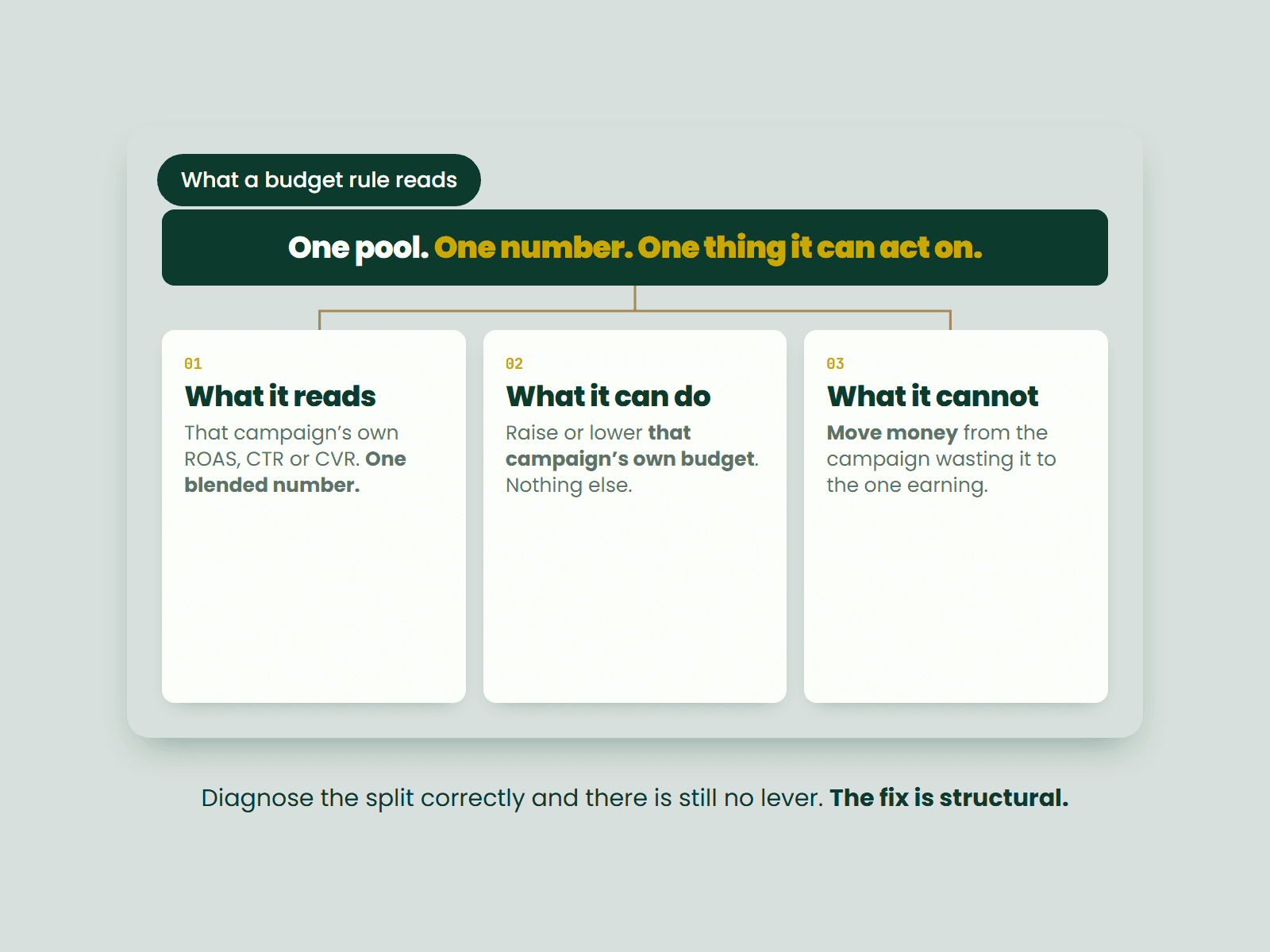
This is the part that ties the structure decision to the money, and it is the reason the two sections above sit next to each other.
A performance-based budget rule fires on the campaign's own aggregate. Amazon's language is a threshold "such as ROAS, CTR, or CVR" met by that campaign. So the number handed to the rule is whatever your grouping produced. Branded defence running efficiently and competitor conquest running expensively, averaged into one figure, and the rule cannot see that it is an average of two things that were never meant to cost the same.
Then the second half of the trap closes. Even after you correctly diagnose which slice is dragging, the only automated lever available raises or lowers that one campaign's budget. It cannot separate what your structure already merged. Give a rule more money and it feeds the whole pool. Give it less and it starves the efficient slice alongside the wasteful one.
Which makes the fix manual, structural and permanent. You split the campaign by hand, rebuild the targeting, and start the new campaign's history from zero. A grouping choice made once, often years ago, at setup, by somebody who was thinking about organisation, sets the ceiling on what any automation can ever act on separately.
The reason it survives so long is that a rule firing on a meaningless number looks identical to a rule working. There is no warning label on the rule that says this threshold is an average of things you did not mean to average.
Two more things locked at the campaign level: negative keywords and placement bids
The budget pool is the headline, and it is not the only thing structure decides.
Negative keyword scope. A negative added at campaign level blocks that term for every ad group inside the campaign. A negative added at ad group level blocks it in that ad group only. If branded and competitor targeting share a campaign, you cannot block a term for one and keep bidding it in the other at campaign level. You have to push the negative down to ad group level, which is more setup and easier to forget. Structure decides which tool is convenient to reach for, and convenience is what people actually do.
Placement bid adjustments. Top of Search, Rest of Search and Product Pages multipliers are set on the campaign and apply to every ad group inside it. You cannot run Top of Search at one multiplier for a hero ASIN and a different one for a slow mover sitting in the next ad group of the same campaign. Group products with genuinely different placement economics together and you have committed them to one placement strategy.
Campaign structure does not hide your search term report, and I nearly wrote that it did
Now the correction, and it is the most useful paragraph in this piece because almost every competing article overclaims it.
The tidy version of this argument says structure decides what you can see. That is overstated and I am not going to run it. Raw performance data is not hidden by how you grouped your campaigns. Search term reports and keyword or target-level reports pull at the target level regardless of structure. If a term is buying clicks in a blended campaign, the row exists and you can go and read it.
What structure genuinely blends is narrower. Default dashboard views, portfolio rollups, and most concretely the trigger number a budget rule fires on. So the honest claim is about blended triggers, not hidden data. Your reporting is intact. Your automation is reading an average.
That narrower version is harder to sell and it is the one that survives being checked, which is the only property worth having in a claim about somebody else's ad account.
Auto campaign vs manual campaign is decided once, at creation
Practitioner consensus across multiple sources, and I could not put a clean Amazon quote behind it in this pass, so take it as high confidence rather than documented: the auto or manual targeting type is set when the campaign is created and cannot be flipped on an existing campaign. To move from auto to manual you build a new campaign. The industry-standard auto to exact migration workflow only makes sense if the type cannot be changed in place, which is decent circumstantial evidence, and it is still not a citation.
The consequence is the same shape as everything else here. An account that has never been rebuilt is running a decision made on day one by whoever set it up, and there was no prompt at setup telling them it was one way.
The out of stock question I could not settle, and the hypothesis sitting on top of it
Flagging this as an open question rather than a finding, because the premise underneath it is genuinely disputed.
Sources disagree on whether Sponsored Products ads stop serving when an ASIN goes out of stock. Some describe an automatic pause with a delay on restock. Others describe ads continuing to serve. No Amazon primary-source statement settling it turned up in this pass, so I am not going to assert either direction.
Here is the untested inference, labelled as such. If ads for an out-of-stock ASIN do stop serving, and that ASIN shares a campaign with others, the budget it was consuming does not sit idle. It becomes available to whatever else in that campaign is still spending, with no decision made by anybody. Your allocation across products would change because of a warehouse event.
That is a hypothesis built on a disputed premise. Do not act on it as fact. It is checkable on your own account, which is more than can be said for most claims in this category, and the related piece budget-rules-cannot-see-stock covers what budget rules can and cannot read about inventory.
How many campaigns should I have? Ask what number a rule would read
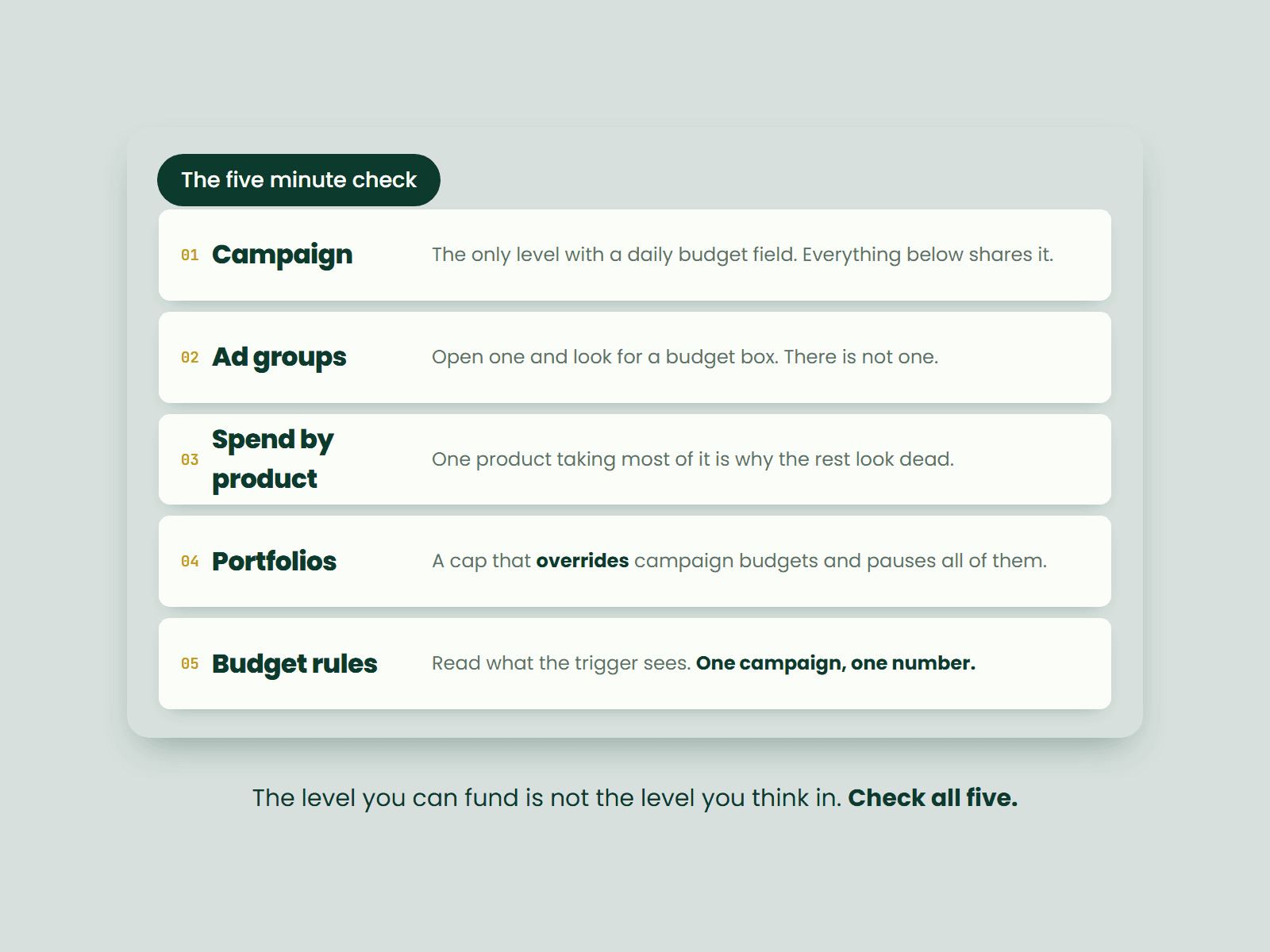
No universal answer exists and anybody offering you one is selling a template. Four questions get you a defensible answer for your own account, and none of them need a tool subscription.
Does one campaign contain targeting with structurally different acceptable costs? Branded defence, competitor conquest and complementary discovery do not share a target ACoS. If they share a campaign, every aggregate number on that campaign is an average of things that were never supposed to cost the same.
If you switched on a performance-based budget rule today, what number would it read? Say the answer out loud. If it represents three strategies stapled together, the rule is tuned to noise and raising its threshold will not fix that.
Is the real ceiling the campaign budget or a portfolio budget cap? Per Amazon's portfolio budget documentation, a portfolio budget overrides your campaign budgets when it is met, the associated campaigns are paused, and the cap does not pace spend across the period, so a single campaign inside the portfolio can exhaust the whole thing. That is the answer to why did all my campaigns pause at once when each campaign's own budget looked fine. Check the portfolio tab before concluding a campaign will not scale, because the constraint may be one floor up.
Do your negatives sit at the level where your strategy actually splits? If the answer is that you have never checked which of your negatives are campaign-wide, that is a twenty-minute read of your own account and it occasionally explains a product line that quietly lost traffic.
What the structural choice costs, in money
The same structure is right for one business and wrong for another, and the deciding factors are boring.
A brand whose own name is not contested barely needs branded defence isolated, because organic is already holding what the ads would be protecting. A brand being conquested on its own name needs that defence separated with its own budget and its own trigger, or a blended campaign will starve it the moment the rest of the campaign looks inefficient by comparison. A four SKU catalogue can run blended and a person can eyeball it. A four hundred SKU catalogue running the same way is undiagnosable by hand, and nobody is auditing hundreds of ad groups for silent drift. A newly launched ASIN in a broad auto campaign is buying information and blending is cheap at that stage. The same blending on a mature ASIN with known winning terms is certainty sitting in a pool with noise.
So the decision is not how to organise the account. It is what you are willing to permanently merge.
Every campaign you leave blended is a slice of budget you cannot route to the intent that earns it, not this month and not with any rule, for as long as the structure stands. The cost is not the hour it takes to split a campaign. It is the difference between the return on the money you meant to spend on acquisition and the return it earns while it sits in a pool with defence, compounding quietly for every month nobody looks. Price that gap once, decide which merges you are content to keep, and the setup hour stops being the expensive number in the conversation.
Working out which of your campaigns are blending intents that should not share a budget is one of the reads a full account audit pulls apart. You keep the findings either way.
Frequently asked questions
Can I set a budget for one product on Amazon ads?
Not in Sponsored Products. The daily budget is a field on the campaign, and ad groups, keywords and ASINs inside it all draw from that one number. There is no ad group budget in the console or in bulk sheets. The only way to give one product its own budget is to give it its own campaign.
Why is one campaign spending all my money?
Because every ad group inside a campaign shares one budget pool, and Amazon does not ration between them by your intent. Whichever targeting inside that campaign gets clicks first spends the shared money. Nothing on the campaign screen shows spend split by strategic purpose, because Amazon does not know which ad group you consider defence and which you consider acquisition.
Why did all my campaigns pause at once?
Check your portfolio budgets tab, not the campaign budgets. Per Amazon's portfolio budget documentation, a portfolio budget cap overrides campaign budgets when it is met and the associated campaigns are paused. The cap does not pace spend across the period, so one campaign inside the portfolio can exhaust the entire cap while every individual campaign budget still looks fine.
Does Amazon move budget between campaigns automatically?
Amazon's own budget rules guide documents two rule types, schedule-based and performance-based, and both act on a single campaign's own budget. It never describes money moving from one campaign to another. Vendor articles published in May 2026 disagree with each other on this, and the one claiming automatic redistribution cites no Amazon source. The narrow exception is a portfolio-level shared unspent budget beta, reported in January 2025, which reuses already-unspent budget inside one portfolio and does not change the budgets you set.
Should I put all my keywords in one campaign?
Amazon's targeting guide advises against mixing different targeting strategies within the same campaign and ad group. The same guide says testing broad, phrase and exact on the same keyword is fine, because you are not bidding against yourself by adding match types on one keyword. Separate by intent, not by syntax.
Can I change an auto campaign to a manual campaign?
Practitioner consensus across sources is that the targeting type is fixed when the campaign is created and you build a new campaign to change it. No single clean Amazon statement confirming this was located in this pass, so treat it as high confidence rather than documented. The auto to exact migration workflow that every operator runs only exists because the type cannot be flipped in place.
I raised my daily budget and it does not seem to spend more. Why?
The daily budget is averaged over the calendar month rather than enforced daily. Amazon's budget guide describes spending up to 25% more than the average on a given day, and a policy change dated 9 May 2023 added an option for up to 100% more, selectable in Settings or through the average daily budget API. A single day's spend against a single day's budget is the wrong comparison.
Sources
Primary, Amazon's own pages. Sponsored Products budget basics and best practices for the campaign daily budget definition and monthly averaging, an undated page read in this pass. New sponsored ads daily budgeting policy and options, dated 9 May 2023, for the 25% and 100% overage options. A complete guide to budget rules for the two rule types, both acting on one campaign's own budget, undated. A guide to targeting with Sponsored Products for the mixing-strategies quote and the match-type quote, undated. Maximize order delivery with the new budget optimization system, dated 10 September 2024, DSP-scoped and named as a different product in the body. Portfolio budgets and Understand portfolios for the cap override, the absence of pacing and single-campaign exhaustion, plus Unspent campaign budget in portfolios (beta). Those support pages are JS-rendered and did not return readable text on direct fetch, so they are cited via search snippet.
Secondary, vendor sources, named because the disagreement is the point. sellermetrics.app, Amazon's New Budget Rules Explained, dated 5 May 2026, the source of the uncited dynamic-allocation and purchase-intent claims. off-hours.app, Amazon Ads Budget Rules, dated 15 May 2026, the direct contradiction. JumpFly on the shared unspent budget across portfolios beta, dated 21 January 2025. Vendor explainers on negative keyword scope and placement bid adjustments were consulted for the scope mechanic only.
Checked and excluded. Cross-campaign automatic budget redistribution in Sponsored Products, asserted in May 2026 vendor content with zero citation and contradicted by the silence of Amazon's own guide. The "up to 25% overage when Amazon detects high purchase intent" framing, which has no primary source and appears to misstate the confirmed 2023 averaging policy. The 1,000 campaign-level and 1,000 ad group-level negative keyword limits, repeated identically across vendor blogs with no Amazon page confirming the figures in this pass, so the scope distinction is used and the numbers are not. The 0% to 900% placement bid adjustment range, vendor-reported and not confirmed against a primary page, so the campaign-wide mechanic is used and the ceiling figure is not. Fixed ACoS or spend-share benchmarks by campaign type, found on one practitioner blog as a system, which is one operator's rule of thumb rather than an Amazon figure. And whether Sponsored Products auto-pauses ads on out of stock, genuinely disputed across sources and left unresolved in the body.
Onieque Edwards
Content Strategist /Blog Writer
Onieque is the brain behind bold Amazon growth strategies and structured business execution. He enjoys turning scattered ideas into clear, actionable systems that actually drive results. When he’s not building out growth plans or refining campaigns, you’ll likely find him exploring new coffee spots or getting lost in ideas that connect strategy with creativity.