← Back to Blogs
Amazon Strategy
16 min read
10 Reasons This Amazon Product Launch Would Fail

Onieque Edwards
Content Strategist /Blog Writer

10 Reasons This Amazon Product Launch Would Fail
Most Amazon product launches are decided before a single unit ships. Not by the product, and not by the launch tactics, but by a handful of assumptions that were never checked with a number.
The failure looks the same almost every time. The listing goes live, advertising turns on, sales are slower than the model said, ACoS runs higher than planned, the budget that was meant to last ninety days is gone in five weeks, and the reorder that would have fixed the ranking never gets placed because the cash is sitting in a container of unsold inventory. At no point in that sequence does anyone conclude the product was wrong. It reads as bad luck, or a hard category, or a listing that needs another round of images.
It usually is not. It is one of ten conditions, and more often it is five of them at once.
1. There is not enough real demand
The product looks good on Alibaba, in a trend report, or in somebody's short-form video. None of that establishes that enough Amazon shoppers are typing something that leads to it.
The warning signs are readable before any money moves:
Keyword search volume that is low, or flat, or visibly declining across the year
Sales concentrated in one narrow keyword with nothing beside it
Demand that only exists inside a trend window
Heavy seasonality that the cash-flow model does not account for
Established competitors accumulating very few new reviews, which is the tell that units are not actually moving
That last one is worth sitting with. A category can look busy, with a dozen listings and thousands of historical reviews, and still be a category where nobody has sold meaningfully in eighteen months. Review accumulation rate is a velocity signal, and it is free to read on the page.
A product with no consistent demand does not become one because the listing got better. Everything downstream in this article assumes demand exists. If it does not, nothing else in the launch matters.
2. The budget covers the inventory and nothing else
This is the most common version of underfunding: enough money to place the first purchase order, and not enough to fund the launch that the purchase order was for.
The costs that arrive after the inventory are the ones that get underestimated:
Advertising, for as long as it takes to gather usable data
Freight, duties and customs
Photography and video
Listing design and A+ content
Coupons and promotional discounts
Amazon's own fees
Returns, damages and the units that get written off
The second purchase order, which has to be placed before the first one has finished selling
Commonly circulated launch guides suggest planning several thousand dollars beyond product cost for the launch itself, with ranges that vary widely by category and competitiveness. Treat those numbers as planning heuristics rather than measurements, because that is what they are. Nobody has published a defensible average, and the ranges you find quoted are built from the author's own client mix.
What is defensible is the shape of the problem. Advertising costs run ahead of advertising returns during a launch by design, because the first weeks are buying data rather than profit. If the advertising budget is sized to a mature ACoS target, it will be exhausted before the account has learned anything worth acting on.
3. The margin does not survive Amazon's actual fees
A product looks profitable when the maths is selling price minus supplier cost. That calculation is not wrong so much as incomplete, and the gap between it and reality is where launches quietly die.
The real number has to absorb referral fees, FBA fulfilment, storage, freight, duties, advertising, returns, discounts and damaged inventory. A thirty dollar product with a fifteen dollar landed cost can still lose money once advertising and Amazon's fees take the rest.
Two dated changes matter here, and both landed in 2026.
Fulfilment fees rose on 15 January 2026, by an average of about eight cents per unit. Referral fee percentages and storage fees were left unchanged. Separately, a 3.5% fuel and logistics surcharge now applies to FBA fulfilment fees in the US and Canada, averaging around thirty-two cents per unit through peak season. Neither figure is large on its own. Both belong in the model, because a launch margin is usually thin enough that the difference between a model and a guess is a few cents per unit.
Amazon's New Selection Program was rebuilt on 30 July 2026, and it changes launch economics more than the fee increase does. For eligible new-to-FBA branded parent ASINs, referral fees are capped at 10% or the seller's existing rate, whichever is lower, on the first 100 units, then 5% on the next 100. There is also free monthly storage on the first 200 units per parent ASIN, waived return processing and liquidation fees within 120 days of first inventory receipt, and 50 dollars of coupon fee credits plus 75 dollars of Vine enrolment credits usable within 60 days of listing.
Three conditions on that, because they decide whether it applies to you at all:
Brand Registry is now a hard gate. The 2026 version covers branded parent ASINs only. The previous program did not exclude non-branded ASINs. A seller running generic listings has lost eligibility for this specific program.
The cap is "whichever is lower". A seller already in a category with a base referral rate under 10% gets nothing extra on those first 100 units.
There is a deadline. Sellers already enrolled received the 2026 benefits automatically as an introductory offer running through 31 October 2026. To keep them on ASINs listed after that date, the updated program terms have to be accepted in Seller Central before it passes.
The credits also do not stack with New Seller Incentives, which applies first. A seller eligible for both should know the order rather than model both in full.
4. Nothing about the product gives a shopper a reason to switch
If the product is functionally identical to ten established listings, the shopper has no reason to pick the one with no reviews.
Weak differentiation is easy to recognise once it is named: the same design, the same colours, the same bundle, the same generic packaging, no defined target customer, and no improvement traceable to anything a competitor's customers complained about.
Differentiation does not have to be dramatic. Better materials, a more convenient format, a genuinely useful bundle, instructions somebody can follow, tighter quality control, or a version built for one specific use case will all do it. What it has to be is legible on the search results page, because that is where the choice is made. A real improvement that is invisible in the main image and the title is not differentiation, it is a feature you will pay to explain.
One dated change makes this sharper than it used to be. Amazon announced in January 2026 that reviews stop pooling across variations that differ by flavour, ingredients, material, fit, design or use case, with the rollout running from February to May 2026. Colour, pattern, size and pack still pool. A differentiated variation now stands on its own review count from day one, which cuts both ways: the differentiation is more visible, and it does not inherit the parent's social proof.
5. The listing cannot convert the traffic the ads are buying
Advertising buys impressions and clicks. The detail page decides whether any of it becomes a sale, and a weak page turns the ad budget into a subsidy for the competitors who appear next to you.
The usual failures are structural rather than stylistic:
A main image that does not communicate what the product is at thumbnail size
Images that never show the product in use, or at scale, or in a hand
A title and bullets written for a keyword tool rather than a person
Benefits stated vaguely enough to be true of anything in the category
Nothing on the page that answers the objection the reviews say people actually have
A mobile layout where the offer is not clear inside two seconds
Fix conversion before scaling spend, in that order, and not because it is tidier. Low conversion on paid traffic is a signal Amazon reads. Spending harder into a page that does not convert buys worse placement at a higher cost, and teaches the system that the listing is not competitive on the terms you most want to win.
6. The advertising is underfunded or unstructured
A launch with no advertising is usually invisible. A launch with advertising that is too small or too narrow is invisible more expensively.
The recurring problems:
Daily budgets exhausted in the first hours, so the listing is absent for most of the day
Bids set below the level that wins any impressions at all
Targeting restricted to the expensive head terms, where a new ASIN with no reviews competes worst
No automatic campaigns, which are the cheapest available source of search-term discovery
No negative keywords, so the same irrelevant terms are paid for repeatedly
Sponsored Products used alone, with no test of Sponsored Brands or Sponsored Display where the category supports them
Performance judged on immediate ROAS during the period whose entire purpose is data collection
Category-specific launch guidance for 2026 puts the practical floor at a level that produces enough clicks per day on the main campaign to optimise inside the first month, and expects launch ACoS to run well above the mature target before reviews and organic rank bring it down. Those numbers are category-dependent and should be rebuilt for yours rather than borrowed. The principle is not: a budget too small to generate data is not a small launch, it is a cancelled one that still spends money.
7. There is no compliant plan for the first reviews
A listing with zero reviews sitting next to listings with hundreds converts worse at every stage of the funnel, and the gap is widest exactly when the advertising budget is largest.
The launch is exposed if there is no compliant review process, if Vine is ignored while the ASIN is still eligible, if early feedback goes unmonitored, if packaging inserts break policy, or if the product ships before known quality concerns are resolved.
Vine is the mechanism most often left on the table, and its rules are specific enough to plan around:
Enrolment is priced in tiers in the US: no charge for up to 2 units, 75 dollars for 3 to 10, 200 dollars for 11 to 30
The fee is only charged after the first Vine review publishes, and not charged at all if no review arrives within 90 days of enrolment
The ASIN must have fewer than 30 existing reviews, and once it passes 30 it is permanently ineligible
Offers must be FBA, on a Professional account, with Brand Registry or an eligible generic product
The number of units enrolled caps the reviews available, so enrolling a handful caps the outcome well below the ceiling
Note how this interacts with reason 3. The New Selection Program's 75 dollar Vine credit is time-boxed to 60 days from listing. Whether Vine is switched on in week one or week ten decides whether that credit is captured at all. These are not two separate decisions.
The objective is never to manufacture positive reviews. It is to have any credible review base at the moment the advertising spend peaks, using Amazon's own compliant routes.
8. Product quality turns the first reviews negative
Early negative reviews do disproportionate damage because they are a large share of a small base. A two-star average across six reviews is a very different commercial position from the same six reviews sitting under four hundred.
The causes are ordinary and largely preventable: breakage or leaking, poor fit or sizing, durability that fails inside the first month, claims the product does not support, packaging that does not survive transit, missing accessories or instructions, inconsistent manufacturing between units, and a product that does not match its own images.
In categories where the buyer is making a safety judgement, this is more severe. Pet products carry concerns about durability, materials and what happens if a component detaches. Supplements carry ingredient, labelling and claim exposure. In both, a quality complaint is not just a conversion problem, it becomes a compliance problem, which is reason 10.
The mitigation is unglamorous. Test the production sample with the intended customer, in the intended use case, before the large order is placed. A quality failure discovered in a review costs the review base, the ranking and the inventory. The same failure discovered in a sample costs a sample.
9. The product goes out of stock during the launch
A launch that is working can still be destroyed by running out, and this is the failure that is hardest to recover from because the damage compounds while nothing is being sold.
Going out of stock costs sales velocity, organic ranking, advertising momentum and visibility at once, and it takes the cash that should have funded replenishment with it.
The recovery estimates published for this vary widely, from one to two weeks up to several weeks for a mature ASIN in a competitive category, and they disagree enough that no single figure deserves to be quoted as fact. What every source agrees on is the asymmetry: the ranking falls quickly and returns slowly, and the return has to be bought at a higher advertising cost than the position originally required, against competitors who absorbed the traffic in the interim.
That asymmetry is the argument for forecasting at least ninety days of sell-through into FBA before launch, with a buffer sized to the actual manufacturing and shipping lead time rather than the optimistic one. Calculate the reorder point before the launch begins, not when the dashboard flags it.
There is one dated detail worth knowing here: the New Selection Program's storage and fee waivers are scoped to the first 200 units per parent ASIN and a 120-day window from first inventory receipt. A launch that is deliberately under-ordered to reduce risk can end up leaving those benefits unused.
10. Compliance and operations were never checked
A product can clear demand, economics, differentiation and every other gate in this list, and still be unable to launch.
The blockers are specific: restricted-category approval, missing testing or certification, claims that are not permitted, trademark or intellectual property complaints, incorrect labelling or packaging, missing documentation, hazmat classification, detail page suppression, and suppliers who cannot produce consistently to specification.
This is heaviest in supplements, where ingredients, claims, labelling, testing and category requirements all have to be reviewed before production rather than after it. A compliance problem stops sales even when demand is strong and the advertising is working, and it usually surfaces at the worst possible moment, which is after the inventory has arrived.
Brand Registry deserves a specific mention, because in 2026 it stopped being purely defensive. It gates the New Selection Program's launch credits, it gates A+ content, and it gates most of the tooling used to diagnose a listing that is not converting. A launch planned without it is a launch planned without the fee relief and without the diagnostic instruments.
If you are looking at a launch that has already gone live and is not working, the useful question is which of these ten is actually binding. Most sellers are told to fix the listing, because the listing is the visible thing. Frequently the listing is fine and the constraint is three layers down. We read the whole account rather than one lever, because the answer to "why is this launch failing" is almost never in the place the symptom appears.
The five that compound
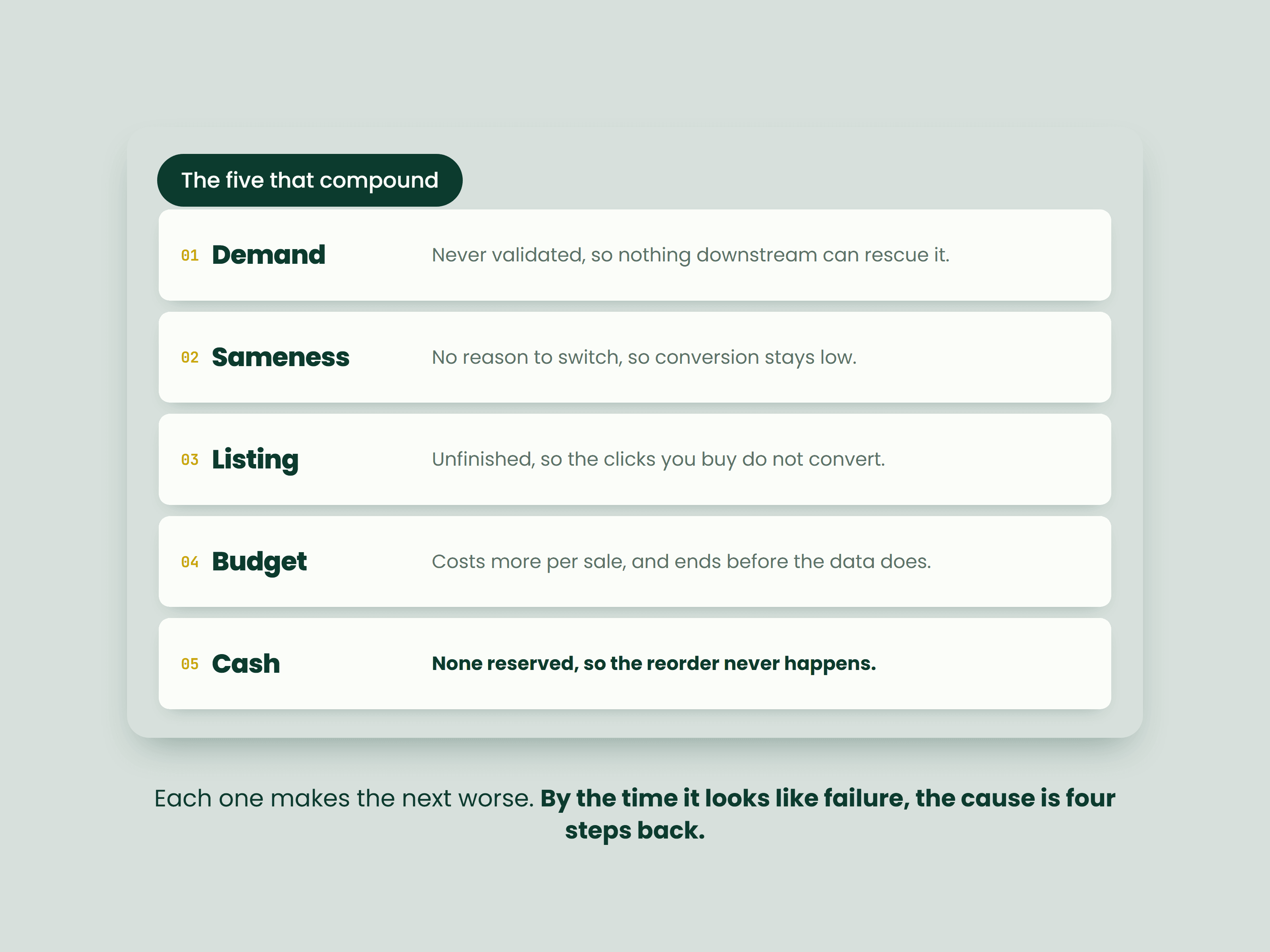
The ten reasons above are not independent risks of equal weight. Five of them form a loop, and when they occur together the launch is not merely at risk, it is running a cycle that additional spending accelerates.
Demand was never validated
The product is not meaningfully different
The listing is unfinished
Advertising is underfunded
There is no cash reserved for replenishment
Read them in sequence and the mechanism is obvious. Weak differentiation suppresses conversion. Low conversion makes advertising more expensive per sale, because the same clicks produce fewer orders. Expensive advertising consumes the budget faster than planned. The exhausted budget means the launch never gathers enough data to fix the targeting, and there is no cash left to reorder. Then the product goes out of stock, the ranking falls, and re-entering costs more than the original position did.
Every step in that loop makes the next step worse. This is why a launch rarely fails for one reason that can be identified afterwards and corrected. By the time it is visibly failing, four other things have gone wrong downstream of the original problem, and the visible symptom is the last one in the chain rather than the cause.
It is also why the fixes have an order. Conversion before spend. Demand before differentiation. Cash reserved before the first purchase order, not after. A launch plan that treats these ten as a checklist to work through in any order will fix the cheap ones and leave the binding constraint in place.
The pre-launch failure test
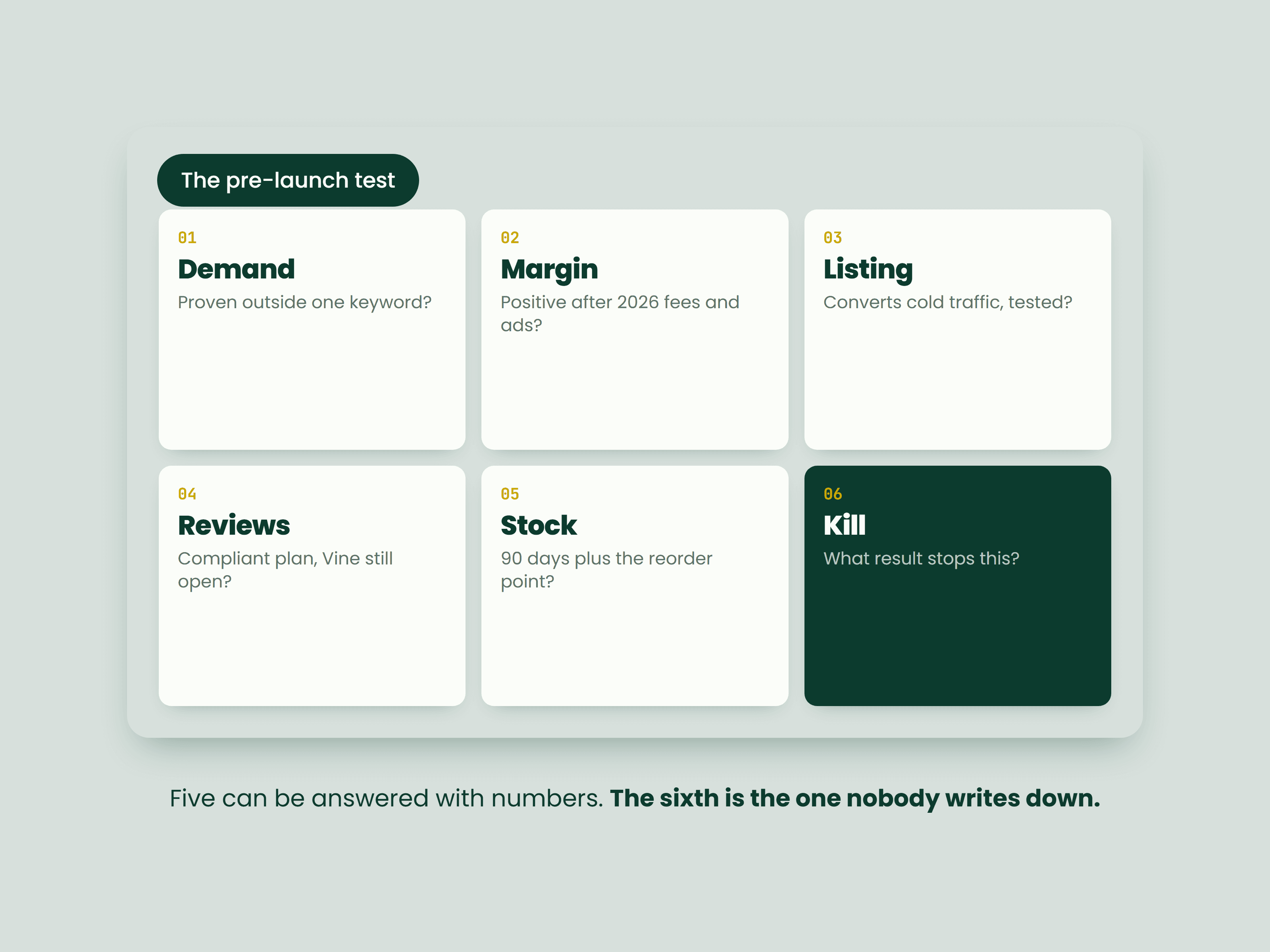
Before approving the launch, answer these with numbers and evidence rather than confidence:
Is there proven, consistent Amazon demand, and does it exist outside one keyword and one season?
Can this product compete against the listings currently winning the terms you need?
Does the margin stay positive after referral fees, fulfilment, storage, freight, duties, advertising, returns and discounts, using current 2026 fee levels?
Is the ASIN eligible for the New Selection Program, and if it is, has the 31 October 2026 confirmation been handled?
Is there enough capital for 60 to 90 days of testing, separate from the inventory?
Can the listing convert cold traffic, tested rather than assumed?
Is there a compliant review plan, and does it use Vine while the ASIN is still under 30 reviews?
Has the production sample passed quality and compliance checks with the intended customer?
Is there enough inventory for the launch and the reorder, with the reorder point already calculated?
Then the tenth question, which is the one that actually matters and the one that almost never gets written down:
What specific result, by what date, would cause you to improve this product, pause the launch, or cancel it entirely?
A launch without that answer cannot be stopped, because there is no condition defined that constitutes failure. It ends when the money ends. Deciding the threshold in advance, while the decision is still cheap and unemotional, converts a launch from a bet into an allocation with a stated downside.
If those questions cannot be answered with numbers, the product is not ready and the correct action is not a better launch plan. It is validating the assumptions first, while the only thing at stake is a week of research rather than a container of inventory and the advertising budget behind it.
That is the whole decision. Not whether the product is good, but whether you know enough to commit the capital, and what you have agreed in advance to do if the answer turns out to be no.
If a launch is on the calendar and you want the ten conditions checked against your actual numbers before the purchase order goes out, that is what the audit does.
FAQ
How much money do I actually need to launch a product on Amazon?
There is no defensible universal figure, and the ranges circulating in launch guides are built from each author's own client mix rather than from published data. The useful framing is structural: budget the inventory, then budget the launch separately, and size the launch budget by how many days of advertising data you need before you can optimise. If the advertising budget cannot survive 60 to 90 days at a launch-stage ACoS well above your mature target, it is too small, whatever the absolute number is.
Is the New Selection Program worth enrolling in for a 2026 launch?
For an eligible new-to-FBA branded parent ASIN, yes, because the benefits are front-loaded onto exactly the units where launch margin is thinnest: referral fees capped at 10% then 5% across the first 200 units, free storage on those units, fee waivers inside 120 days, and coupon and Vine credits inside 60 days. Two caveats. The caps apply only if they are lower than your existing referral rate, so low-referral categories may gain nothing on the first 100 units. And the credits do not stack with New Seller Incentives, which applies first.
What is the 31 October 2026 deadline about?
Sellers already enrolled in the previous New Selection Program were moved onto the 2026 benefits automatically as an introductory offer running through 31 October 2026. To keep those benefits on ASINs listed after that date, the updated program terms have to be accepted in Seller Central before it passes. It is a click rather than an application, which is precisely why it gets missed.
Should I launch without any reviews if I cannot get Vine?
You can, but price the disadvantage into the advertising budget rather than pretending it is not there, because a zero-review listing converts worse on the same traffic and therefore costs more per sale. Check Vine eligibility first: it needs FBA, a Professional account, Brand Registry or an eligible generic product, and fewer than 30 existing reviews on the ASIN. That last condition is permanent once crossed, so the window closes on its own.
My launch is live and underperforming. Where do I look first?
Conversion rate on paid traffic, before anything else. If the listing converts and the problem is volume, it is a targeting or budget problem and it is fixable with money. If the listing does not convert, spending more makes the position worse rather than better, because low conversion on paid clicks feeds back into placement. Diagnose in that order, because it decides whether more budget is the solution or the accelerant.
How long does organic rank take to recover after a stockout?
Published estimates disagree widely, from one to two weeks for a short interruption up to several weeks for a mature ASIN in a competitive category, so treat any single quoted figure with suspicion. The reliable part is the asymmetry: rank falls faster than it returns, and the return is bought at a higher advertising cost against competitors who absorbed your traffic while you were unavailable. That asymmetry, not any specific recovery number, is the argument for the buffer.
Sources
2026 Updates to US Referral and Fulfillment by Amazon Fees, Amazon Selling Partners
Amazon Vine Program 2026: Cost, Eligibility and How to Join, SalesDuo
Amazon splits variation reviews in bid to stop misleading ratings, PPC Land
Amazon PPC budgeting challenges are sinking sales, Helium 10
The True Cost of an Amazon Stockout in 2026, Velocity Sellers
Onieque Edwards
Content Strategist /Blog Writer
Onieque is the brain behind bold Amazon growth strategies and structured business execution. He enjoys turning scattered ideas into clear, actionable systems that actually drive results. When he’s not building out growth plans or refining campaigns, you’ll likely find him exploring new coffee spots or getting lost in ideas that connect strategy with creativity.