← Back to Blogs
Amazon Strategy
12 min read
Your Amazon ACoS Target Was Set Before Anyone Read The Account

Onieque Edwards
Content Strategist /Blog Writer

Your Amazon ACoS Target Was Set Before Anyone Read The Account
"Get ACoS down to 25%."
That sounds like a goal. It is a conclusion, and somebody reached it before anyone read the account.
Ask where the 25 came from and the answer is almost always one of five things. A benchmark article. The previous agency's target. A competitor's claim on a podcast. A number that felt uncomfortable last quarter. Or a slide that needed a figure on it.
None of those know your margin. None of them know what is actually holding the account down. And a target set without either is not a target. It is a number with a percent sign after it.
What ACoS is actually made of
ACoS is advertising cost of sale: ad spend divided by the sales those ads are credited with, expressed as a percentage. Spend $20, get $100 of ad-attributed sales, and the ACoS is 20%.
That figure means nothing on its own. It only acquires meaning when you put it next to the one number that decides whether a sale was worth making.
Break-even ACoS is your gross margin. Take the selling price, subtract cost of goods, fulfilment, the referral fee and every other landed cost, and divide what is left by the price. A $40 product with $24 of all-in cost has $16 of margin. That is 40%. At exactly 40% ACoS, advertising consumes the entire profit on an advertised unit and you break even on it.
Which means the same "good" number is two different decisions in two different accounts:
At a 40% margin, a 25% ACoS is comfortably profitable and probably too conservative.
At a 22% margin, a 25% ACoS loses money on every single order.
So the first problem with "get ACoS to 25%" is that nobody checked whether 25 is above or below the line where the product stops paying for itself.
But fixing that only gets you a correct ceiling. It still does not tell you where the next dollar should go. That is a different question, and it is the one that actually decides what the account does next.
A channel brief arrives with the answer already inside it
Most Amazon agencies are hired to run a channel. The brief lands with the work already specified:
Lower the ACoS.
Scale the spend.
Fix the listing.
Launch the new range.
Read those again as what they are. Every one is a conclusion. Somebody looked at a symptom, decided what was causing it, chose the response, and handed over the response as if it were the task.
The agency that accepts that brief is not being paid to find out what is wrong. It is being paid to execute somebody else's read of what is wrong. If that read was right, the work goes well. If it was wrong, the work is done properly and the account still does not move, and everyone spends two quarters wondering why the execution failed when the execution was never the problem.
We start from the other end.
What is actually capping this business right now?
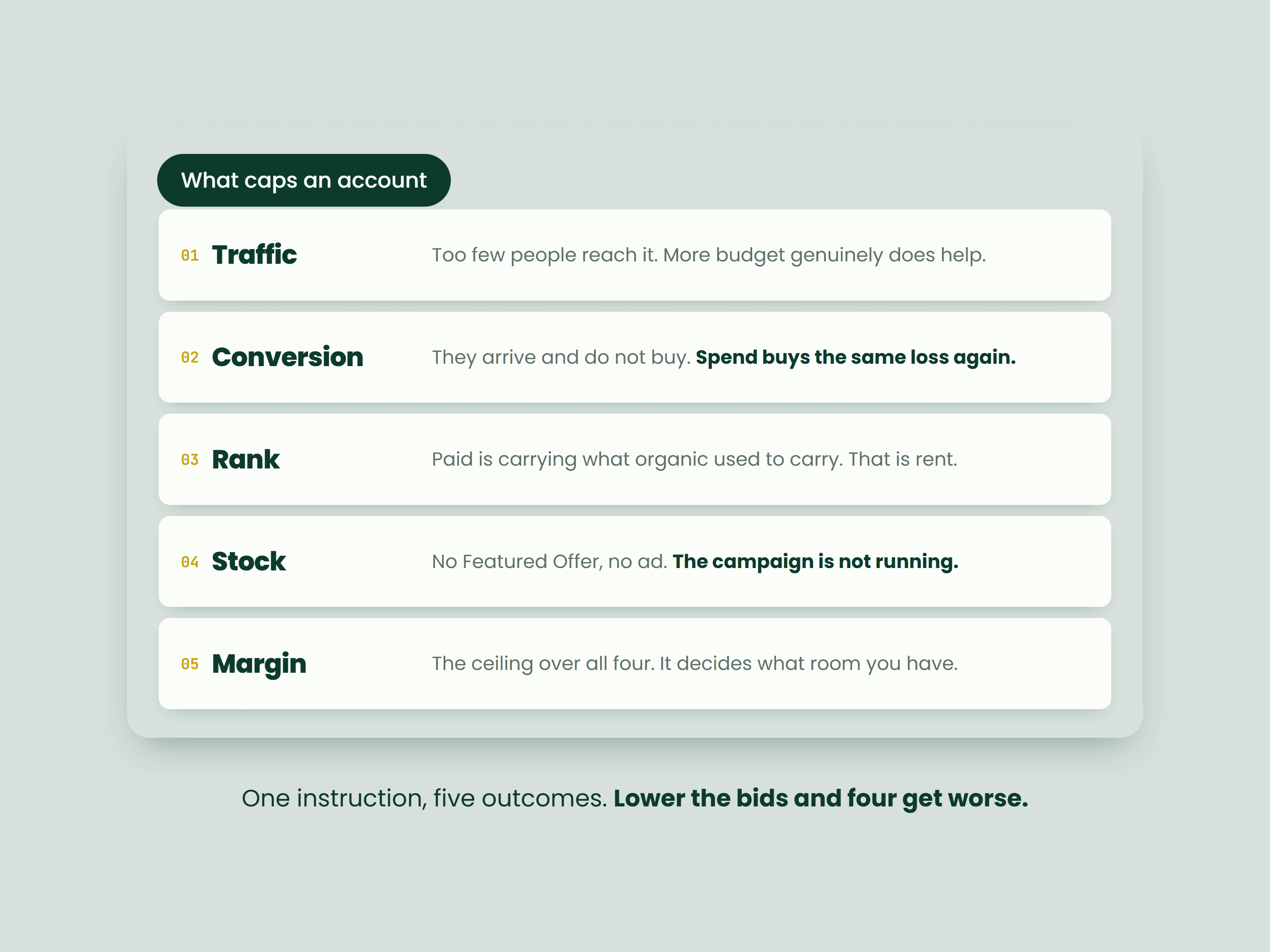
There are five common answers. Only one of them is advertising.
Traffic. Not enough people are seeing the product at all. Impressions are thin, the ranked keyword set is narrow, and the category's real demand is going somewhere else. More budget genuinely does help here, which is why this is the case where a channel brief accidentally gets it right.
Conversion. Plenty of people arrive and few of them buy. The listing, the price, the images, the review count or the delivery promise is losing the sale after the click has already been paid for. Every extra dollar of ad spend buys another chance to lose in the same place.
Organic rank. Paid is carrying traffic that organic used to carry, or should be carrying. The account looks like it is spending more to stand still, because it is. Advertising becomes rent on a position rather than an investment in one.
Stock and the Featured Offer. Availability, price competitiveness and delivery speed decide whether the offer is even the one Amazon shows. More on this below, because it is the hardest evidence in the whole argument.
Margin. The ceiling on every decision above. A thin margin does not just set a low break-even ACoS, it removes the room to buy rank, absorb a launch, or hold a position against a competitor who has more room than you do.
Now put a bid change against each of those. Lowering bids into a traffic cap makes the cap worse. Lowering bids into a conversion cap hides the problem by buying fewer clicks to lose. Lowering bids into a rank slide accelerates the slide. Lowering bids into a stock problem does nothing at all, because the ads were not the reason the sales stopped.
One instruction. Five different outcomes, four of them wrong, and the brief cannot tell you which one you are in.
Amazon's own rule puts advertising last
This is the part that is not an opinion.
To advertise a product with Sponsored Products, that product has to be eligible for the Featured Offer. Amazon's own guide for new advertisers states it plainly: if you create an ad for a listing that is not eligible for the Featured Offer, the ad will not display to customers, and ineligible ads are flagged as such in campaign manager.
Read what that means for the order of operations. Whether your campaign runs at all is decided by price competitiveness, by being in stock, and by delivery speed. Those are inventory, pricing and operations decisions. Not one of them lives in the advertising console, and not one of them responds to a bid.
Amazon is currently changing part of this. Starting in July 2026 it began removing seller eligibility requirements for the Featured Offer, rolling out gradually across its stores and completing by the end of 2026. What is being removed is the upfront screen on seller performance metrics. What explicitly remains is the offer-level selection, which Amazon describes as continuing to evaluate offers on the criteria most important to customers, naming competitive pricing, delivery speed and performance.
So the account-level gate is coming down. The offer-level one is not. Price and availability still sit upstream of every bid you will ever place.
There is a version of this that costs real money and gets misdiagnosed constantly. Impressions fall off a cliff, the graph looks like a broken campaign, and somebody starts raising bids to fix it. The campaign was not underperforming. It was not running, because a competitor took the Featured Offer on price or the ASIN went out of stock, and the ad had nowhere to appear. Every bid increase in that window is a change made to a system that is switched off.
And the auction was never only about your bid
Even inside advertising, the bid is not the lever it is treated as.
Amazon runs a second-price auction, so the winner generally pays what it takes to beat the next bid rather than their full maximum. But the bid is one input among several. The consensus among people who work in these accounts every day, based on what Amazon publishes and on what the data shows, is that placement is decided by bid together with relevance to the query, expected click-through, and the listing's own history of converting clicks into orders.
Amazon does not publish the weighting, so nobody can tell you exactly how much each part counts. What matters here is the direction, and the direction is not in dispute: a listing that converts well can win placement more cheaply than a listing that converts badly and bids higher.
Which puts the listing upstream of the bid a second time. Conversion is not just where the money is lost after the click. It is part of what the click costs in the first place.
That is the whole reason "just lower the ACoS" is such an expensive instruction. Lower bids reduce spend. They do not improve any of the things that were making the clicks expensive.
Why a PPC-only engagement will not find this
An agency looks where its scope points it.
If the contract says manage the advertising, then the console is the field of view, and the console's data is real but partial. It will show you that conversion on paid clicks dropped. It will not show you that it dropped in the same week a competitor cut price by $6, or that the main image changed, or that the delivery promise slipped from two days to five because the inventory moved to a further warehouse.
One flag is noise. Correlated flags are a finding. Reading advertising against price, listing, reviews, stock, returns and rank is not extra work bolted onto PPC. It is the only way to know whether the advertising number in front of you is the problem or the symptom.
An agency that only manages advertising is not being careless when it misses this. It is being consistent with the brief it was given. That is exactly why the brief is the thing worth arguing with.
The Canopy Read
So our order is fixed, and it does not change per client:
Understand the account. What it sells, at what margin, into what demand, against whom, with what stock position and what history.
Diagnose what is capping it. Traffic, conversion, rank, stock or margin. Named, with the evidence that points there and the alternatives that were ruled out.
Set the goal that comes out of the diagnosis. With a ceiling that traces to the margin, a horizon, and a stated trade.
Then execute.
We call the first two steps the Canopy Read, and it happens before a single bid is touched. It is the first phase of the Canopy Method, and it is the part that decides whether the rest of the work is aimed at anything.
A target is an output of that. Never an input to it.
What a target looks like when it is an output
Compare the two.
An input: *get ACoS to 25%.*
An output: *break-even is 40%, so hold blended ACoS at or under 32% on the terms we already rank for, and run the discovery set at up to 55% through week six, because the organic position that buys is worth more over the next two quarters than the margin it costs this month. Revisit at week six if organic rank on the head terms has not moved.*
The second one is longer, and that is the point. It carries four things the first one does not have:
A ceiling that traces to the margin, so it is arithmetic rather than preference.
A split, because defending a position you hold and buying one you do not are different jobs with different economics.
A horizon, so the money has a period to work in.
A condition to revisit it, agreed in advance, while the decision is still cheap.
That last one is what separates an allocation from a bet. A target with no stated condition for changing it cannot be wrong. It can only be missed.
And this is also where TACoS earns its place. Total advertising cost of sale measures ad spend against total sales, not just ad-attributed sales. If ACoS holds steady while TACoS falls, advertising is buying organic ground. If ACoS improves while TACoS is flat or rising, the account is getting more efficient at renting a position it never manages to own. The first is compounding. The second is a subscription.
The question that replaces it
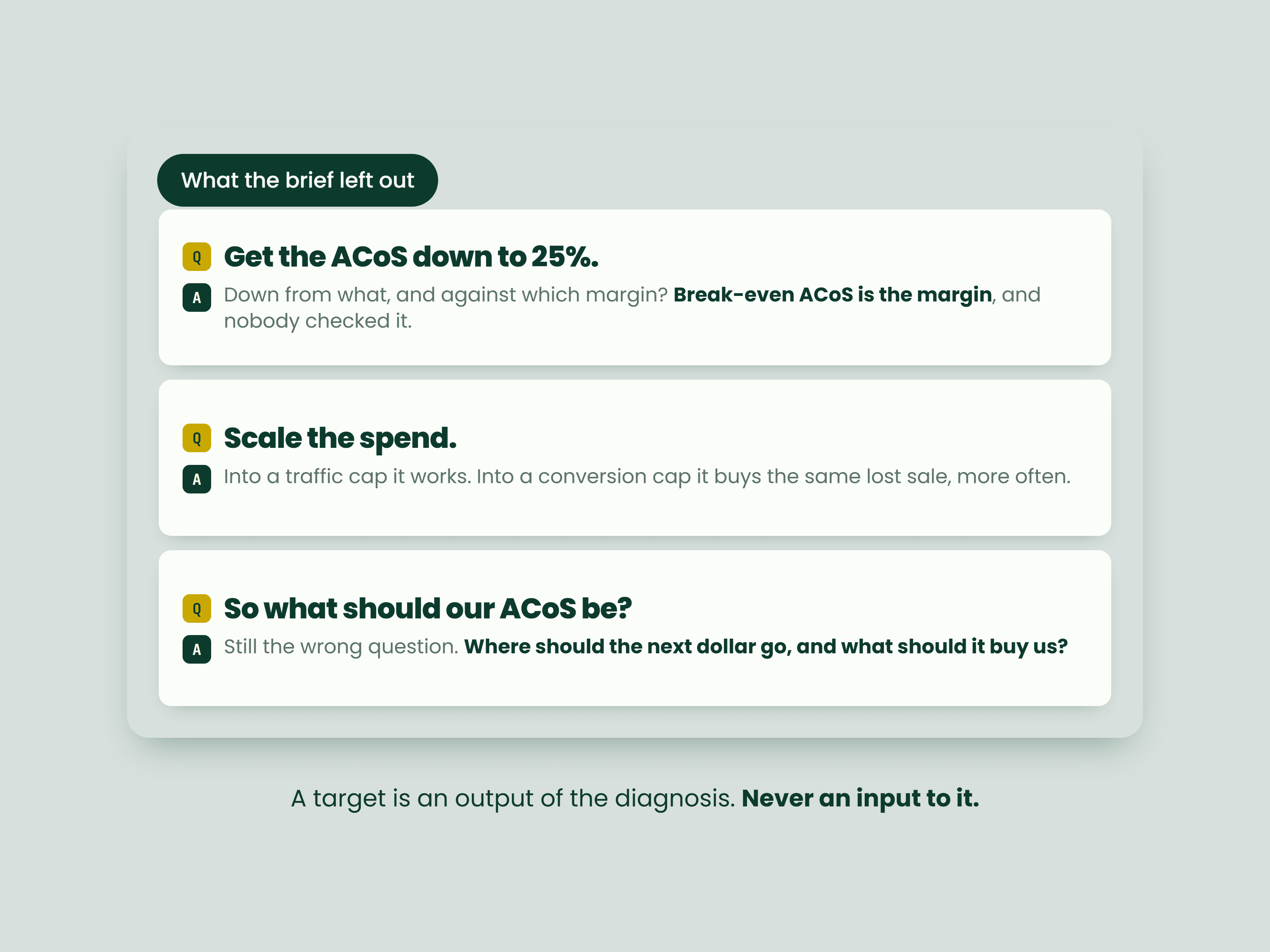
"What should our ACoS be?" has no answer yet, and pretending otherwise is how two quarters get spent optimising the wrong thing.
The real question is the one that decides where money goes:
Where should the next dollar go, and what should it buy us?
Sometimes the answer is advertising. Often it is the listing that is losing the click you already paid for, or the price that is costing you the Featured Offer, or the stock position that turns your campaigns off for eleven days a quarter. Those are not smaller problems than the bids. They are further upstream, which is what makes them worth more.
The number at the end is real, and it matters. It is just the last thing to decide, not the first.
If a target has already been set for your account and nobody has checked it against the margin it is supposed to protect, that is what the audit does.
FAQ
What is a good ACoS on Amazon?
There is no universal figure, and any article giving you one has skipped the only step that matters. A good ACoS is one that sits correctly against your break-even ACoS, which equals your gross margin after cost of goods, fulfilment, referral fees and every other landed cost. A 30% ACoS is healthy on a 45% margin and loses money on a 25% margin. Work out the break-even number first, then decide how far under or over it a given campaign should sit and for how long.
How do I calculate my break-even ACoS?
Selling price minus all costs, divided by selling price. A product at $40 with $24 of combined cost of goods, fulfilment and Amazon fees leaves $16, and $16 divided by $40 is 40%. At a 40% ACoS, advertising consumes all the profit on an advertised unit. Below it you are profitable on those units; above it you are paying for something else, such as rank or a launch, and that should be a deliberate decision with an end date.
Should I lower my bids if my ACoS is too high?
Only if you know why it is high. Lower bids reduce spend, which reduces ACoS by shrinking the numerator, but they do not fix a listing that converts badly, a price that is losing the Featured Offer, or an organic position that is sliding. In three of the five common cases, cutting bids makes the underlying problem worse while making the report look better. Diagnose the cause first, because the same action has opposite consequences depending on what is actually capping the account.
Is ACoS or TACoS the better target?
They answer different questions and you want both. ACoS measures efficiency inside advertising: spend against ad-attributed sales. TACoS measures ad spend against total sales, so it shows whether advertising is buying organic ground or renting a position indefinitely. ACoS steady with TACoS falling is the shape you want. ACoS improving while TACoS stays flat usually means the account is getting better at paying for traffic it should have earned.
Why did my Amazon ads suddenly stop getting impressions?
Check whether the product still holds the Featured Offer before you touch anything else. Products must be eligible for the Featured Offer to advertise with Sponsored Products, and an ad on an ineligible listing does not display, with the ineligibility flagged in campaign manager. Going out of stock or being undercut on price can therefore switch a campaign off entirely, which reads on a graph exactly like a campaign that has stopped performing. Raising bids in that window changes nothing, because nothing is serving.
How long should the diagnosis take before anyone changes a campaign?
Long enough to read the account against itself rather than one metric in isolation, which in practice means looking at advertising, listing, price, reviews, rank, stock and returns together, and long enough to name what was ruled out as well as what was found. The point is not the calendar time. It is that no bid should change until there is a stated cause, because a change made against the wrong cause still costs money and still consumes the weeks you would have used to find the right one.
SOURCES
Updates to Featured Offer eligibility requirements, Seller Central Forums
Maximize Your Sales Potential with the Amazon Featured Offer, Amazon
Amazon ACoS: Formula, Benchmarks and How to Lower It, Ad Badger
What Is a Good ACoS on Amazon? Benchmarks and Break-Even Math, Accrue
How Amazon's Ad Algorithm Works: Impressions, Indexing and Auction Mechanics, PPC Ninja
Onieque Edwards
Content Strategist /Blog Writer
Onieque is the brain behind bold Amazon growth strategies and structured business execution. He enjoys turning scattered ideas into clear, actionable systems that actually drive results. When he’s not building out growth plans or refining campaigns, you’ll likely find him exploring new coffee spots or getting lost in ideas that connect strategy with creativity.