← Back to Blogs
Amazon Ads
11 min read
Should You Turn Off Amazon Ads If You Already Rank Organically? What Amazon Actually Documents

Onieque Edwards
Content Strategist /Blog Writer

Should You Turn Off Amazon Ads If You Already Rank Organically? What Amazon Actually Documents
A seller sits in the top three organically for a term and sees their own Sponsored Products ad running above their own listing. The question writes itself. Why pay for a click you would probably get for nothing?
Amazon does not answer it. There is no help page saying it is safe to pause ads on a keyword you already rank for, and none saying it is dangerous. Folklore fills the gap on one side, vendor blog posts fill it on the other, and neither is evidence about your account.
So this is an investigation rather than a rule. I put the question to an AI agent as a single job: find the terms where the organic position is strong and the bid is still aggressive. What came back was not a pause list. It was a hypothesis with a test and a monitoring window attached, and that is the correct shape of the answer.
Why did my sales drop when I paused ads on a keyword I ranked for?
The old advice is tidy. Rank top three organically, switch the ads off on that term, keep the margin. It gets repeated in seller groups and in agency decks, and no Amazon documentation supports it in either direction.
What exists instead is a consistent set of practitioner reports pointing the other way. Vendor posts describing accounts that killed ads on strong terms put the drop in the region of 60 to 70 percent within days, and they explain it through sales velocity rather than any direct link between ad spend and rank. Ads were carrying units. Units were carrying rank. Remove the first and the second follows a few days later.
Treat those numbers as what they are. The posts are undated, they publish no methodology, and none is a controlled study. Marketplace Valet's version is representative rather than authoritative. The figure is not the useful part. The direction is, because independent sources with no reason to agree keep landing in the same place.
Amazon's nearest published claim leans the same way and does not cover this case. On 29 September 2025 Amazon Ads published a post arguing that video ads can help improve organic ranking. Read the underlying study. It is regional, covering more than 10,000 products in the UAE and KSA during 2024, and it is about video ads. Nothing in it speaks to Sponsored Products in the US.
Amazon does not give you an organic rank number anywhere in Seller Central
This decides whether the investigation is possible at all, and it is the part most people get wrong.
The report everyone reaches for is Search Query Performance, in Seller Central under Brands, then Brand Analytics, then Search Query Performance. It needs Brand Registry. It gives you the search query, the query score, query volume, impressions, clicks, cart adds and purchases with your share of each, delivery speed splits, and price.
Every one of those counts blends organic and paid together. There is no organic column, no paid column, and no field called organic rank anywhere on it. The documented column list carries no such field, and there is no second console screen that does.
So when somebody tells you they read your organic rank off an Amazon dashboard, one of two things is true. They inferred it from blended numbers, which is a guess with decimals on it, or they read it from a third-party rank tracker, which is a different tool with a different data source.
That changes the shape of the job. Finding terms where you rank organically and still bid hard is a join between an Amazon-native report and a rank signal Amazon does not produce. Two sources, matched on the search term. One agent with one job undersells it, because the job is a join, and joins are where the errors live.
AI agents can reach the Amazon Ads API now, and Amazon says that alone is not enough
Until this year the practical objection was that no agent could get near the data. On 2 February 2026 Amazon Ads put its MCP Server into open beta, announced by Paula Despins, VP of Ads Measurement, at the IAB Annual Leadership Meeting. MCP is the protocol that lets an outside AI agent call a service's functions in plain language. Here that covers campaign create, update and delete, reporting queries, account-level settings and billing data, globally, for partners holding active API credentials. It follows Ads Agent, the conversational assistant Amazon put inside the console at unBoxed on 11 November 2025.
The sentence worth your attention is Amazon's own. "This connectivity alone doesn't guarantee reliable outcomes," the announcement says, and it goes further: "without guidance, agents must piece together how individual steps fit together, and they don't reliably produce the best results."
That is the vendor of the API saying that wiring an agent to it does not produce good decisions. It is why Amazon shipped pre-built multi-step workflow tools instead of leaving agents to chain raw calls. The argument for diagnosing before acting is being made by Amazon here, not by me.
What the check actually joins: organic rank, PPC spend, bid and placement
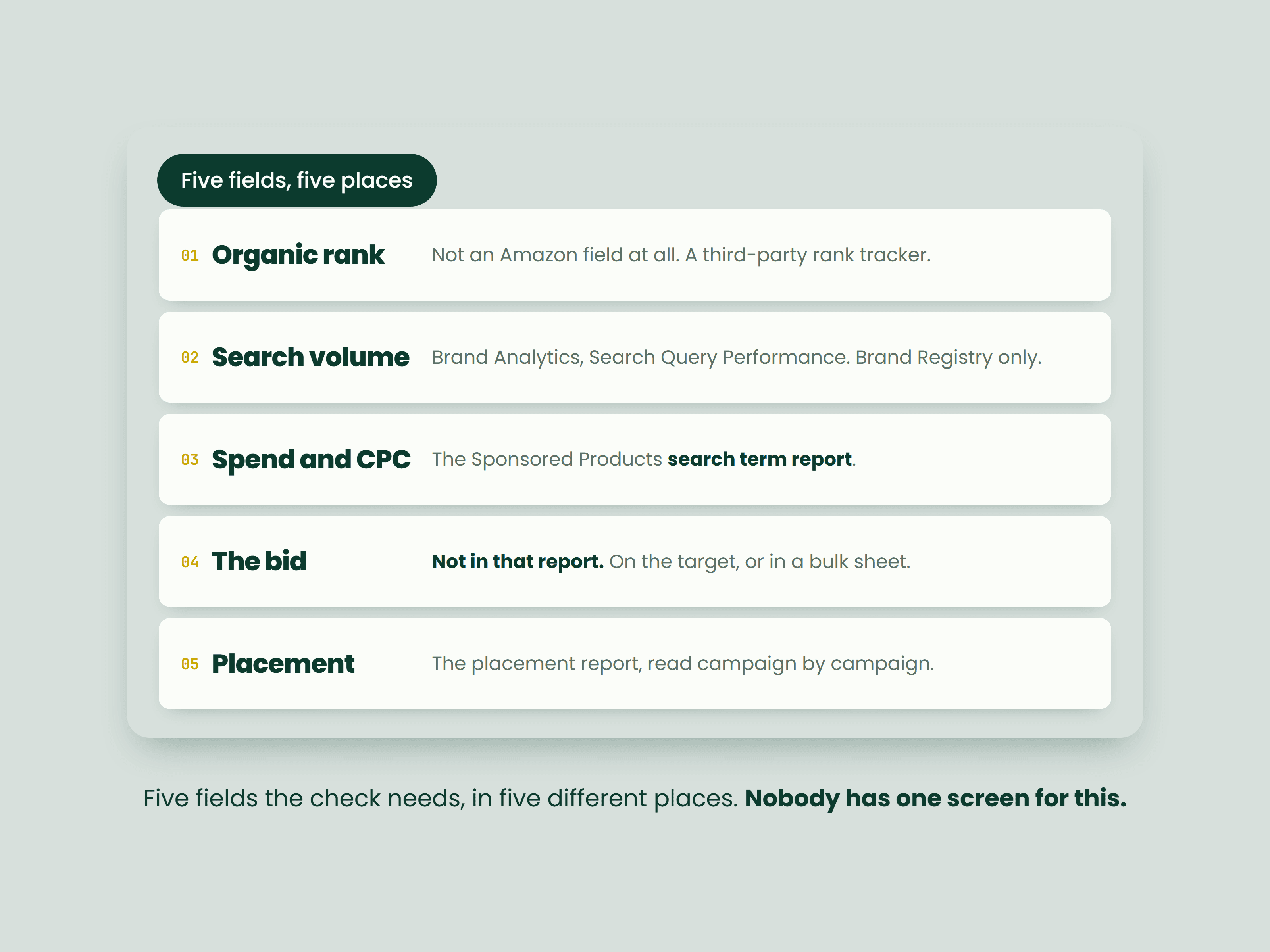
The agent's output was useful because of what it refused to return. Asked for terms that are over-bid, it did not hand back the highest-spend terms, and it did not hand back the best organic positions. It returned the intersection, and only where several readings lined up at once.
What gets read against each other:
organic position for the term, from the rank tracker, not from Amazon
PPC spend and PPC sales for the same term, from the search term report
the bid and the current CPC, which show how hard the term is being defended
impressions and clicks, which show whether the paid placement is where the traffic actually is
total search volume for the term, from Search Query Performance
direction of travel, meaning whether that organic position has held or has been drifting
placement, from the placement report, the Sponsored Products breakdown that splits performance by top of search, rest of search and product pages
whether a competitor is currently advertising on the same term
The thresholds that turn that into a shortlist are the part I keep. The shape is the part worth taking. One flag is noise, correlated flags are a finding, and a keyword that merely ranks well is not a candidate for anything.
Separate one thing that gets confused with this. Two of your own campaigns bidding on the same keyword is campaign cannibalisation, and Amazon's auction already resolves it by picking one of your ads per query. That is a setup problem. Paying for a term you already own organically is an allocation problem, and Amazon resolves nothing for you there.
Reduce the bid instead of pausing, then watch total units for seven days
Say the recommendation on a term is a 15 percent bid cut with a seven-day window. Nothing is switched off, nothing is negated, and the campaign keeps running.
What you watch is not the campaign. Ad-attributed sales on that term will fall, by design, and reading that fall as the result is the mistake that kills the test on day three. Watch total units and total sales for the ASIN, and watch the organic position for the term. If total units hold while spend on the term drops, the paid click was buying a customer who was arriving anyway. If total units fall alongside the spend, the paid placement was doing work the organic position was never going to cover on its own.
On the window, practitioners cite 7 to 14 days. Fourteen is the more standard read. Seven is the compressed version, defensible in a high-competition category where volume accumulates fast enough to read in a week, and thin anywhere else. Pick the window before the test, not after seeing the first three days. If units hold, cut again. Stepwise reduction gives you a floor you discovered rather than a rule you inherited.
One setting interferes here and is worth naming. Dynamic bidding lets Amazon raise or lower your bid in real time based on how likely a click looks to convert, so on a term running up-and-down bidding your stated bid is a starting point rather than the price paid. Read the actual CPC alongside the bid, or you will credit your cut with a move Amazon's bidding made on its own.
A sales dip during the test can hurt the organic rank you are protecting
Here the honest version parts company with the tidy one. A bid reduction is not an observation. It is an intervention on the same organic position it is trying to protect.
If the cut produces a real dip in units inside those seven days, that dip feeds the ranking system as a signal in its own right, because sales velocity is one of the inputs. A test that goes badly moves the thing it was measuring, and a position you were trying to hold for free gets cheaper for somebody else to take.
That is not a reason to skip the test. It is a reason to keep it small and to time it. Do not run it during a launch, in a week when cover is already thin, while a competitor has just cut price, or on the ASIN carrying the category. Run one keyword group at a time, so a dip has one candidate explanation instead of four.
Measuring this properly means Amazon Marketing Cloud, and that is gated by spend
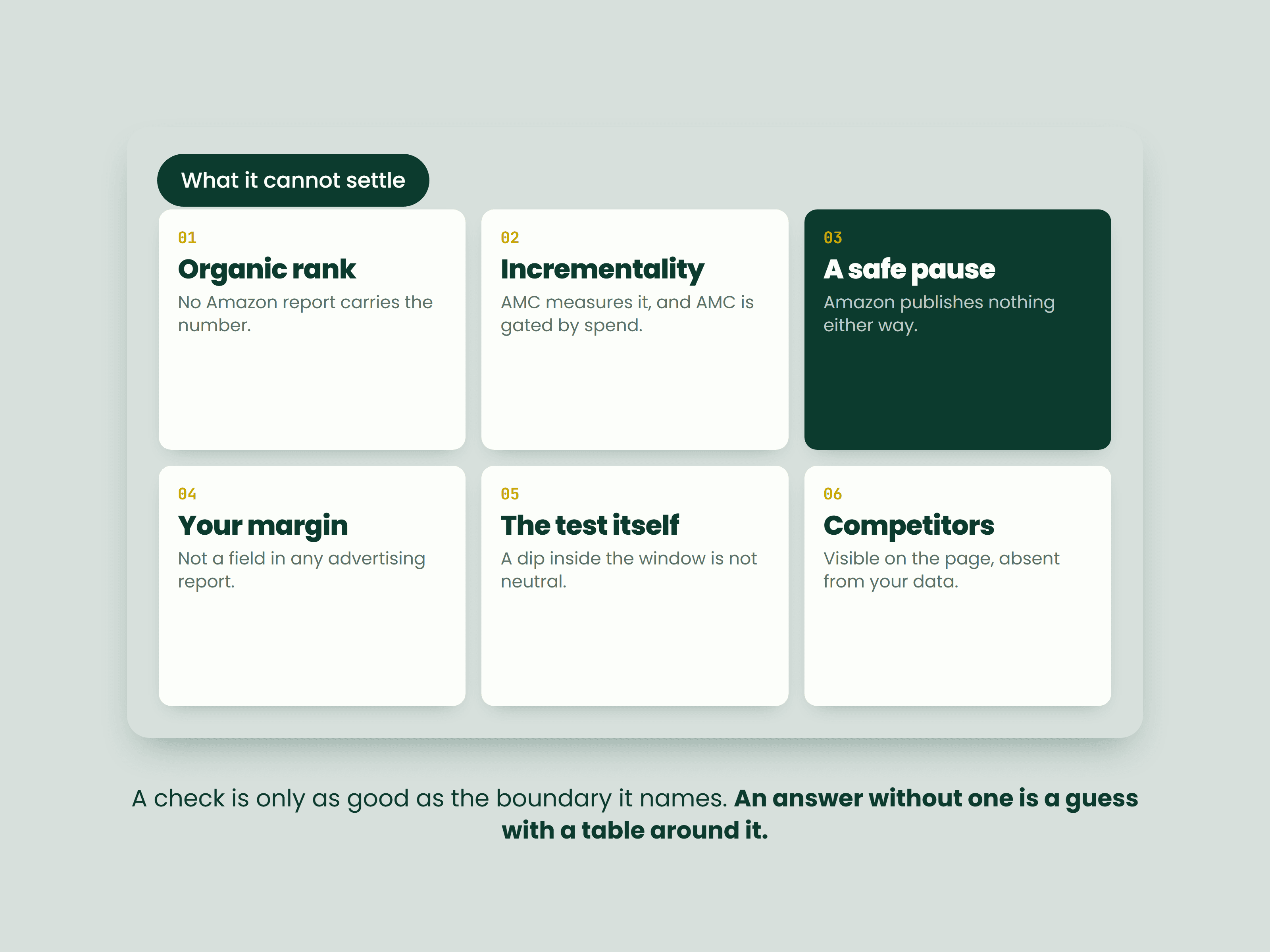
Everything above is inference. The question underneath has a proper name. Incrementality is the share of those sales that would not have happened without the ad, and Amazon has a tool for it. Amazon Marketing Cloud now accepts sponsored ads advertisers without DSP registration, so the door is open to far more sellers than it used to be.
The gate is signal, not eligibility. Comparing groups needs enough events to compare, and vendor estimates put the practical self-serve floor somewhere around 10 to 15 thousand dollars a month in ad spend. That figure is a vendor estimate and Amazon publishes no threshold, so hold the number loosely and the direction firmly.
Which leaves a tension worth saying out loud rather than smoothing over. The seller who most needs to know whether their PPC is buying traffic they already have is usually the seller spending too little to measure it properly. They are left with the bid test, which is weaker evidence and the only evidence available to them. Anyone selling that seller a confident incrementality number is selling a number, not a measurement.
What I checked for this article and would not claim
A quiet change to Sponsored Products dynamic bidding in late April 2026. One vendor blog reports it, with CPC rises across competitive categories and no Seller Central notification. The language is hedged throughout, there is no Amazon confirmation, and nothing corroborates it. If it is real it changes the arithmetic of every bid test here, which is exactly why it stays out until somebody can date it.
The 60 to 70 percent drop figures as a benchmark. They are in here as reported claims and nothing more. No methodology, no dates, no study. Do not build a forecast on them.
That Amazon's video ads result transfers to Sponsored Products in the US. Different format, different region, and Amazon never claimed the transfer.
What this decides: which term your next PPC dollar defends
Strip out the mechanics and one decision is left, and it is about allocation.
Every term you rank for organically has a defence cost. Sometimes that cost is zero because the position holds on its own. Sometimes it is the bid you are paying to sit above your own listing. Most sellers never find out which, because the two numbers never appear on the same screen and Amazon has no plans to put them there.
A bid reduction test prices it. If total units hold at a lower bid, the money released was buying a position you already owned, and it can go to a term you do not own yet. If units fall, you now know the real price of holding that position and can decide whether it is worth paying, which is a different conversation from assuming it is free.
That is the return on this work. Not a lower ACoS to report at month end. A budget where every dollar defends a position you have priced, instead of one you inherited.
If you want to know which of your terms are being paid for twice, that is one of the reads a full account audit pulls apart. You keep the numbers either way.
Frequently asked questions
Should I turn off Amazon ads if I am already ranked number one organically?
Not as a rule, because no Amazon documentation supports the rule in either direction. Practitioners consistently report heavy sales drops after a full pause on a strong term, explained through sales velocity feeding organic rank. The safer version of the same idea is a bounded bid reduction with a monitoring window, which gives you the information without handing the position to a competitor while you find out.
Why did my sales drop when I paused ads on Amazon?
The common explanation is that ad-driven units were part of the sales velocity holding your organic position up. Pause the ads, units fall, and rank follows a few days later, so the organic traffic you were relying on shrinks as well. That mechanism is reported widely by practitioners and is not documented by Amazon, so treat it as the working theory rather than a rule.
Does Search Query Performance show organic rank?
No. Search Query Performance blends organic and paid traffic in its impressions, clicks, cart adds and purchases, and it carries no organic rank field. It is Brand Registry only, under Brands, then Brand Analytics, then Search Query Performance. A clean organic position comes from a third-party rank tracker, not from a native Amazon report.
How long should a bid reduction test run on Amazon?
Practitioners cite 7 to 14 days. Fourteen is the more standard read, and seven is the compressed version that only holds up in a high-competition category with enough daily volume to be readable in a week. Decide the window before you start, and watch total units for the ASIN rather than ad-attributed sales for the term.
Do I need Amazon Marketing Cloud to answer this properly?
AMC is where incrementality gets measured, and eligibility now extends to sponsored ads advertisers without DSP registration. The practical limit is signal volume, with vendor estimates putting useful self-serve work somewhere around 10 to 15 thousand dollars a month in spend. Amazon publishes no threshold. Below that level the stepwise bid test is the honest substitute.
Sources
Introducing the Amazon Ads MCP Server, Amazon Ads, 2 February 2026. Open beta date, capability list, and both quoted lines.
How video ads can help improve organic ranking, Amazon Ads, 29 September 2025. Regional study, more than 10,000 products, UAE and KSA, 2024.
Expanding AMC eligibility to advertisers and partners, Amazon Ads. Undated on the page, so the eligibility fact is used without a date.
Amazon opens its advertising APIs to AI agents, ppc.land, 2026. Corroborates the MCP beta and dates the unBoxed Ads Agent launch.
Ad Tech Briefing: Amazon launches MCP server for agent-driven advertising, Digiday, 2026.
Amazon Search Query Performance Report: complete analysis guide, Amalytix. Column list reference.
Why turning off ads kills sales and rankings on Amazon, Marketplace Valet. Undated practitioner claim, flagged as such above.
Amazon Marketing Cloud minimum ad spend, eVanik, 2026. Vendor estimate, not an Amazon-published threshold.
Onieque Edwards
Content Strategist /Blog Writer
Onieque is the brain behind bold Amazon growth strategies and structured business execution. He enjoys turning scattered ideas into clear, actionable systems that actually drive results. When he’s not building out growth plans or refining campaigns, you’ll likely find him exploring new coffee spots or getting lost in ideas that connect strategy with creativity.