← Back to Blogs
Amazon FBA
15 min read
How To Get More Reviews On Amazon Without Getting Suspended: The 2026 Rules, Dated

Onieque Edwards
Content Strategist /Blog Writer

How To Get More Reviews On Amazon Without Getting Suspended: The 2026 Rules, Dated
Your review count has barely moved in months. The product still sells, the rating is holding, and reviews arrive at a trickle. The instinct at that point is to ask harder, and asking harder is where Amazon accounts die.
So this runs in that order. What you are not allowed to do, said plainly and first, because part of it is now a federal matter and not only an Amazon one. Then the tools you are allowed to use, with the real windows, the real costs, and one correction that most articles on this subject get wrong. Then the part almost nobody writes about, which is that the number you are trying to move sits downstream of three other numbers on your account, and no amount of asking touches any of them.
Operators call that number review velocity. It just means how many reviews a listing earns per unit of time, usually per month or per hundred orders. I use the term for the rest of the piece.
The review requests that get an Amazon account suspended
Amazon's Customer Product Reviews policy and its Communication Guidelines both spell this out. Nothing below is a grey area or an interpretation.
Nothing may be offered in exchange for a review. No money, gift card, free or discounted product, refund, reimbursement, or any future benefit. The rule reads the same in a buyer-seller message, on a packaging insert, and in an email sent off Amazon entirely.
You may not ask for a positive review, and you may not ask for a review only if the buyer had a good experience. Screening for the happy customers before you ask is the same violation as asking for five stars.
You may not ask a reviewer to change or remove a review, with or without an incentive attached.
You may not route unhappy buyers to a private feedback form while pointing happy ones at the review button. That is the practice the policy calls diverting negative reviews, and it is named specifically.
No reviews from you, your staff, your family, or your business partners, on your own products or a competitor's.
No false variation relationships built to pool ratings. Amazon files that under reviews, not only under catalogue integrity.
The consequences Amazon names in its own document: removal of every review on the product, blocking of future reviews, permanent delisting, suspension with funds withheld, referral to civil or criminal authorities, and public disclosure of the seller's name.
The insert card question comes up constantly, so treat it directly. Every prohibition above applies to a packaging insert exactly as it applies to a message. I could not put a clean, currently dated Amazon page in front of you defining the permitted shape of a neutral review-request insert during this research pass, so I am not going to describe one. What I can say is that the insert route carries the most risk of any option here for the least gain, because Amazon's own button does the same job inside Amazon's own system, on Amazon's own wording, with no interpretation required from you.
The FTC rule that sits on top of Amazon's review policy
Since 21 October 2024, the Federal Trade Commission's Rule on the Use of Consumer Reviews and Testimonials has been in force. It is a federal rule and it operates separately from anything Amazon enforces. It bans fake and incentivised reviews, bans paying for reviews whether positive or negative, requires insiders to disclose their relationship, and bans review suppression.
The civil penalty for a knowing violation runs up to $51,744 per violation. Per violation, not per campaign.
That changes the arithmetic behind the old excuse. "Amazon probably will not notice a small insert card" used to be a bet against one enforcement system. Since October 2024 it is a bet against two, and only one of the two can be answered with a plan of action.
The Request a Review button works 5 to 30 days after delivery, one time per order
Seller Central, Orders, Manage Orders, the Shipped tab, open the order, Request a Review.
The window is confirmed from two directions that agree. Amazon's SP-API developer documentation states the call must be made within a time frame of five days after the earliest delivery date to 30 days after the latest delivery date, and a call outside that window returns an error. Separately, Seller Central forum guidance and third-party tool documentation describe the button in plain terms as usable once per order, 5 to 30 days after the delivery date.
Amazon's Communication Guidelines is the seller-facing rule underneath both. Proactive Permitted Messages, review requests included, must be sent within 30 days of order completion, and the document lists a repeat request per order for a product review or seller feedback as a Permitted Messages violation.
The message the button sends is Amazon's own. It asks for a product review and seller feedback in one message, and you cannot edit a word of it. That is the entire feature.
Nothing here moved in 2026. If you find a page telling you the window just changed, that page is wrong, and a later section explains how a wrong page survives for years.
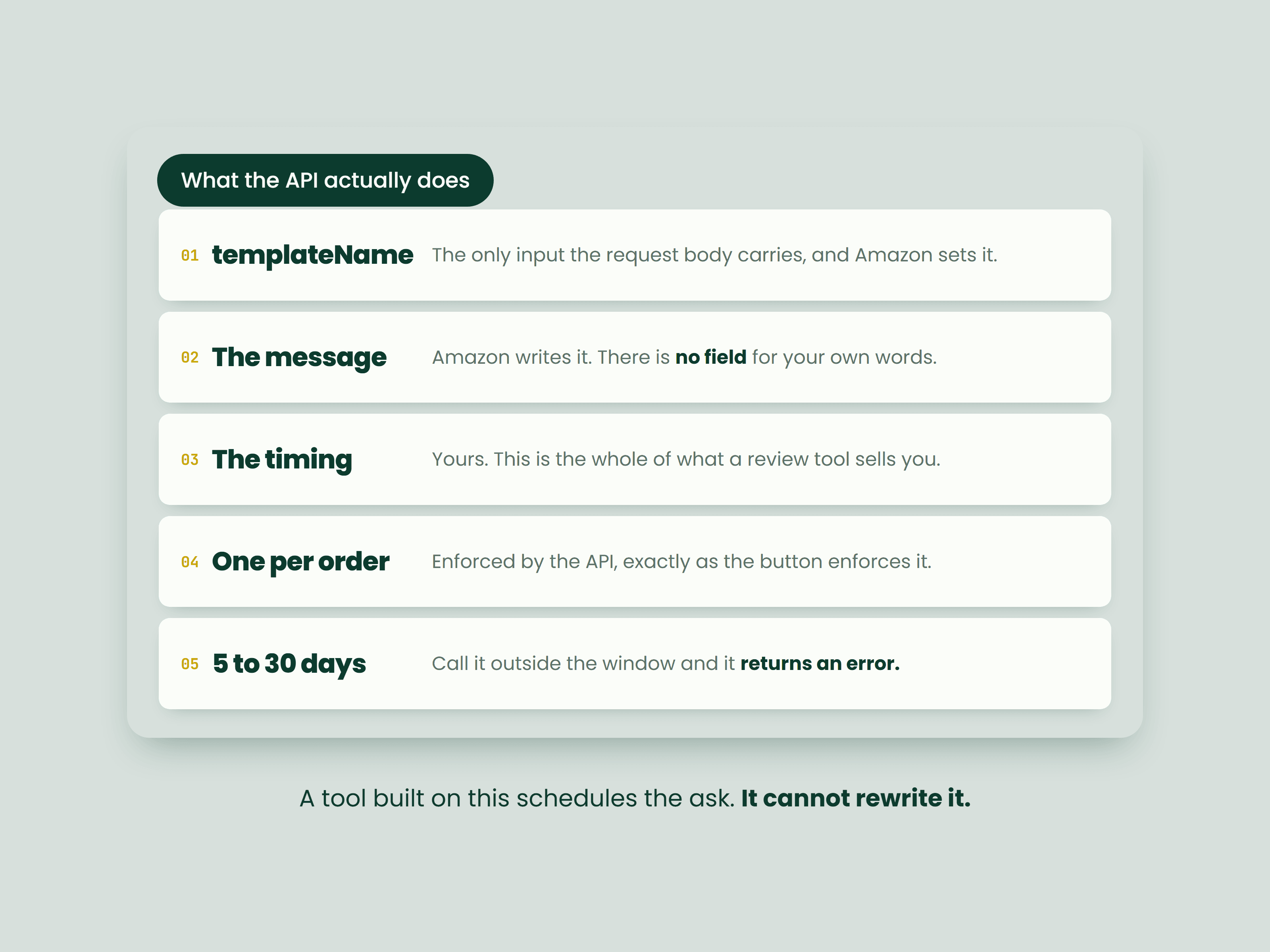
Automated review request tools cannot change the message. The Solicitations API has no field for it.
This is the correction worth the price of the article, because the confusion it clears up is the one sellers bring to a sales call.
The relevant operation is createProductReviewAndSellerFeedbackSolicitation. Its request schema exposes one input: the name of the template. There is no field for message text. Not a restricted field, not a moderated one, not a field that opens up at some seller tier. The field does not exist.
A tool built on that API automates when the request goes out. It cannot touch what it says. The default rate limit is one request per second with a burst of five, and one solicitation per order, matching the button exactly.
So when a vendor sells you better-converting review request copy on the back of this API, they are describing a capability the API does not have. What you are buying is a scheduler. A scheduler is genuinely worth money, because clicking a button on a few hundred orders a week does not reliably happen by hand. It is worth knowing that is what you are buying before you compare two vendors on the strength of their message templates.
Amazon Vine costs $0, $75 or $200 per parent ASIN, not $2,500
Amazon restructured Vine's enrolment fees on 19 October 2023, and that structure is still the one in force:
$0 for up to 2 units and 2 reviews
$75 for up to 10 units and 10 reviews
$200 for up to 30 units and 30 reviews
All three are per parent ASIN. You can move up a tier within the first 30 days of enrolment by adding units. You cannot move back down once it has started.
Now the correction. At least one ranked seller-advice page still quotes a flat $2,500 per ASIN for Vine, undated. That figure predates the October 2023 restructure by years and contradicts every current tier. If you costed Vine off a page like that and concluded it was too expensive for your margin, you priced a decision that does not exist. The real top tier is $200 plus the cost of goods and the fulfilment on 30 units.
One Vine detail I will flag rather than assert. Several agency write-ups state that the enrolment fee is billed seven days after the first review publishes, and waived if no review appears within 90 days. It is consistent across those sources and I could not put it on an Amazon-hosted page in this pass. Treat it as commonly reported, confirm it on your own enrolment screen, and do not budget on it until you have.
Vine is a launch tool. One enrolment per ASIN, for the life of the ASIN.
The product has to be in Brand Registry. Enrolment is gated to listings under a low review count, and the window can close mid-enrolment if the ASIN crosses that threshold while you are in it. Each ASIN can be enrolled once in its lifetime, and re-enrolment stays blocked even after a merge or a variation change.
The specific cutoff commonly cited is fewer than 30 total reviews at the time of enrolment. That figure is consistent across multiple independent vendor sources and I could not pull it off an Amazon-hosted page directly, so read it as well corroborated rather than primary sourced, and check it against your own enrolment screen before you plan around the exact number.
What matters more than the number is the shape. Vine and organic review velocity are sequential on a given ASIN, never parallel. Vine runs at the start, once. After that window closes, the only compliant levers left on that listing are the neutral request tools and the order volume feeding them. A mature listing with a stalled review count has either already spent its enrolment or has passed the point where it could.
Which makes Vine money launch money. It is budgeted before the listing matures, or the access to it quietly expires.
An Amazon-hosted PDF still lists the Early Reviewer Program as a live option
Worth its own section, because it is a checkable example of a trap that costs sellers real decisions.
One of the documents carrying the clearest version of Amazon's review prohibitions is a training PDF hosted on Amazon's own domain, titled "Understanding Amazon Policies on Customer Product Reviews." It presents the Early Reviewer Program as a current alternative to Vine.
Amazon discontinued the Early Reviewer Program on 25 April 2021.
The prohibition language in that document matches every current source I checked, so its rules are still worth reading, and I used them. Its product information is five years out of date, on Amazon's own domain, with no visible date stamp anywhere on it to warn you.
The lesson is bigger than reviews. Hosted on Amazon does not mean current. Before you act on an Amazon PDF, find the same rule on a live Seller Central help page or in the developer documentation, where at least the version moves. A page with no date is a page you cannot age, and this one has been telling sellers to use a programme that has not existed since 2021.
Check sessions and returns before you touch the Request a Review button
Here is the part that decides whether anything above will work, and it is the part almost every guide on this topic leaves out.
Every review request is gated to an order. The button needs one. The API needs one. A Vine unit needs one. Review velocity has a hard ceiling set by how many orders entered that 5 to 30 day window, and no solicitation tactic anywhere raises that ceiling.
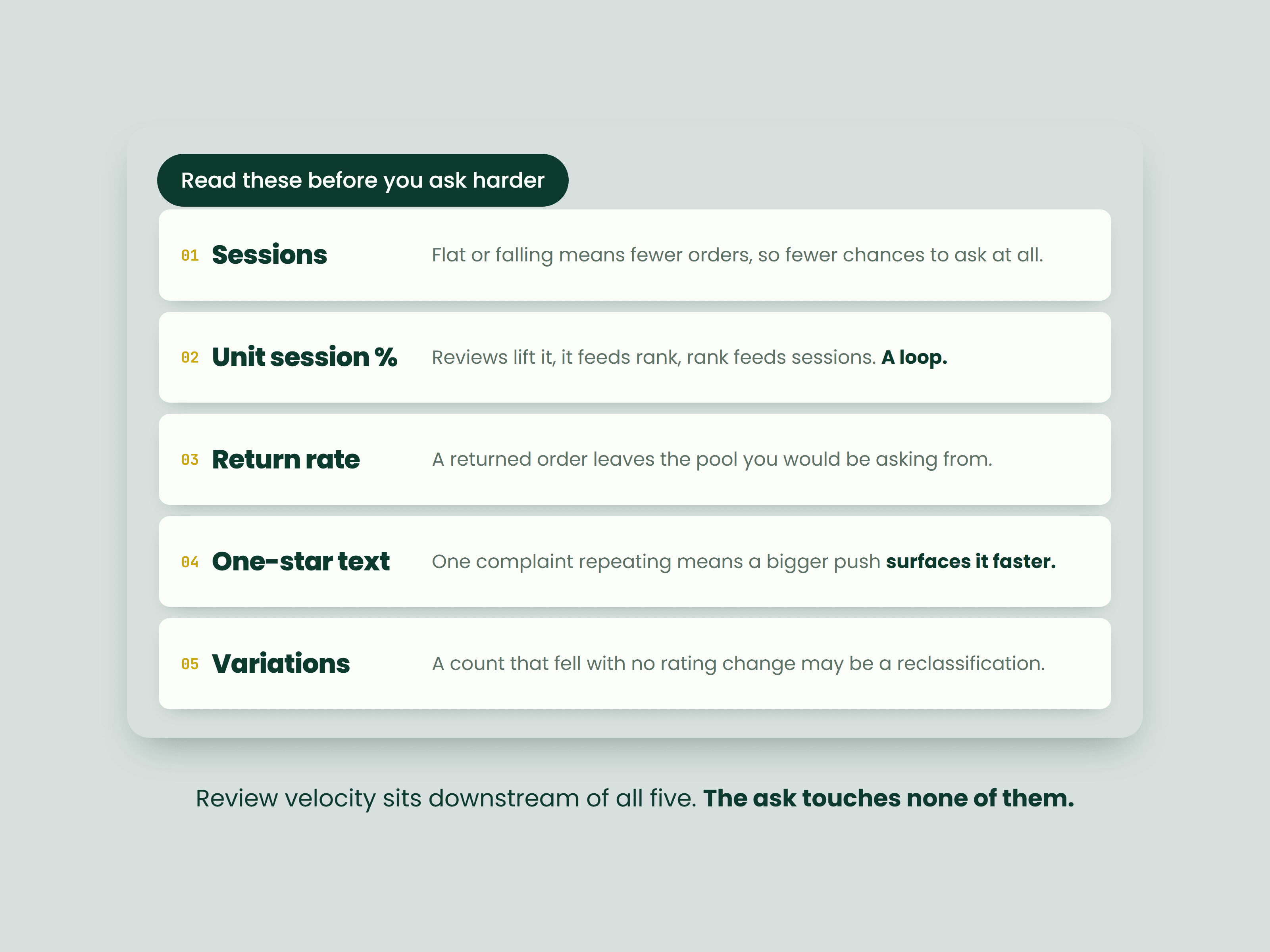
So open Business Reports and read three numbers next to the review count before you touch anything.
Sessions
If sessions are flat or falling, review velocity is falling because less traffic is converting into fewer orders. There is nothing wrong with your asking. That is a traffic and rank problem wearing a reviews costume, and the fix sits upstream of everything in this article. Buying a review scheduler here buys you automation for orders that are not arriving.
Unit session percentage
Unit session percentage is the share of sessions that turn into orders, which is Amazon's version of a conversion rate. It runs in both directions with reviews, and that is what makes this a loop rather than a lever.
A better review count and rating lifts unit session percentage, because buyers read reviews to decide. A better unit session percentage feeds organic rank. Rank drives sessions. Sessions produce orders. Orders produce the review opportunities you started from. Any guide that names the asking step and stops has named one gear of the machine and called it the engine.
Return rate, and the one-star text behind it
A high return rate or a recurring one-star complaint does two things at once, and the second is the one that hurts.
It removes orders from the review-eligible pool, because a returned order is not a kept and reviewed order. And it means any push on the request button surfaces the complaint faster and louder than it would have surfaced on its own. On a listing with an unresolved defect, asking harder trades a slow quiet decline for a fast visible run of one-star reviews. The instinct actively backfires, and it backfires in public.
One more thing belongs in this read, as a flag rather than a cause. Amazon split review sharing across variation children between 12 February and 31 May 2026, so a child ASIN can now display its own reviews where it used to display the whole family's. If a review count dropped with no return spike and no rating change, check the variation family before you assume a review removal or a manipulation flag.
A review count that stopped moving is one flag, and one flag is noise. Put it next to sessions that held flat and a return rate that climbed in the same weeks, and you have a finding. The action that finding points at is not a review request.
Which ceiling is holding your Amazon review count down
Three shapes, and each one wants money in a different place.
Healthy sessions, healthy unit session percentage, low return rate, review count still crawling. This is the one case where the problem genuinely is solicitation. The orders are there and the request is not reaching all of them. Check what share of eligible orders actually receive the request, because manual clicking across a few hundred orders a week does not happen reliably, and the orders that fall outside the 30 day window are gone permanently.
Falling sessions. The review count is a symptom and not the disease. Everything in the first half of this article will work exactly as designed and produce almost nothing, because it is being applied to a shrinking pool.
Kept orders fine, returns climbing, or the same complaint repeating in the one-star text. Fix the product or the expectation the listing sets before you accelerate anything. The reviews you would be speeding up here are the ones you do not want more of.
And the launch case sits outside all three. Under the review threshold, in Brand Registry, enrolment unspent. That is Vine, and it is the only window you get on that ASIN.
What this decides about where the review budget goes
Review velocity gets treated as a solicitation problem because solicitation is the only part of it anyone can sell you. There is a tool for the asking. There is no tool for the ordering.
So the budget question is not which review tool to buy. It is which of the three ceilings is holding your review count down, because the money goes somewhere different in each case, and in two of the three it does not go to a review tool at all.
The one place the arithmetic is genuinely clean is Vine, and it is clean because it expires. Once an ASIN passes its enrolment window, that money has nowhere to go on that listing again, ever. If you have SKUs sitting under the threshold with an unspent enrolment, $200 at the top tier plus goods and fulfilment buys an asset that stays on the listing and keeps converting after the spend stops. Put that next to what $200 of Sponsored Products buys on the same listing. One of the two stops working the day you stop paying.
On a mature listing there is no review tool to buy, and understanding that is worth more than any tool on the market. Whatever is capping velocity there is order volume, conversion, or returns, and each of those is a different line in the budget with a different payback.
Go and read the review count against sessions, unit session percentage and return rate on your top five SKUs before you approve a review tool subscription, because those numbers decide whether the subscription is the right purchase or an expensive way to automate a problem you do not have.
If you want a second read on which of those ceilings is capping review velocity across your catalogue, which SKUs still have an unspent Vine enrolment, and what the one-star text is telling you about returns, that is one of the things a full account audit resolves. You keep the findings either way.
Frequently asked questions
Can I ask a customer to leave a review on Amazon?
Yes, through Amazon's own neutral request. You may not ask for a positive review, you may not offer anything in exchange, and you may not ask only the customers you believe were happy. The safe route is the Request a Review button in Seller Central, or the Solicitations API, both of which send Amazon's fixed wording rather than yours.
How many days after delivery can I use Request a Review?
Between 5 and 30 days after delivery, once per order. Amazon's SP-API documentation puts the window at five days after the earliest delivery date to 30 days after the latest delivery date, and a call outside it returns an error. A second request on the same order is a Permitted Messages violation.
Can the Solicitations API send my own review request message?
No. The request schema exposes only the name of a template. There is no field for message text at all, so any tool built on the API automates the timing of Amazon's own message and nothing else. The default rate limit is one request per second with a burst of five.
How much does Amazon Vine cost in 2026?
$0 for up to 2 units, $75 for up to 10, and $200 for up to 30, all per parent ASIN, under the fee structure Amazon introduced on 19 October 2023. If you have seen $2,500 per ASIN quoted, that page has not been updated since before that restructure.
Is Amazon Vine worth it?
It depends on whether the ASIN is still inside its window, because Vine is a launch tool and each ASIN gets one enrolment for life. On an eligible listing, $200 at the top tier plus goods and fulfilment buys reviews that stay on the listing after the spend stops, which is a different kind of purchase from an equivalent amount of Sponsored Products. On a mature listing the question does not arise, because the option has already closed.
Are insert cards asking for reviews allowed?
Every review prohibition applies to a packaging insert exactly as it applies to a message, so no incentive, no asking for a positive review, and no diverting unhappy buyers. I could not put a currently dated Amazon page in front of you defining a permitted neutral insert, so I am not describing one here. The Request a Review button does the same job inside Amazon's system with none of the interpretation risk.
Will Amazon suspend me for asking for reviews?
Not for using the Request a Review button or the Solicitations API, which are Amazon's own tools sending Amazon's own message. The listed consequences apply to incentives, positivity steering, review gating, insider reviews, and variation manipulation, and they run up to permanent delisting and suspension with funds withheld. Since 21 October 2024 the same conduct also carries a federal civil penalty of up to $51,744 per violation under the FTC's reviews rule.
Why did my Amazon review count go down overnight?
Check the variation family first. Amazon split review sharing across variation children between 12 February and 31 May 2026, so a child that used to display the family's pooled reviews may now display its own. A drop with no return spike and no rating change points at that reclassification rather than at a review removal.
Is the Early Reviewer Program still available?
No. Amazon discontinued it on 25 April 2021. An Amazon-hosted training PDF still presents it as a live alternative to Vine, which is a useful reminder that a document sitting on Amazon's domain is not automatically current.
Sources
Amazon primary. The Communication Guidelines for the 30 day Permitted Messages window, the one-request-per-order rule and the prohibition list. The Solicitations API v1 reference and createProductReviewAndSellerFeedbackSolicitation for the 5 to 30 day window, the template-only schema and the rate limit. The Vine enrolment fee page for the tiers dated 19 October 2023. And the Amazon-hosted training PDF "Understanding Amazon Policies on Customer Product Reviews" for the prohibition and consequence lists, flagged above as stale because it still presents the Early Reviewer Program as current.
US government primary. The Federal Register final rule, published 22 August 2024 and effective 21 October 2024, with the FTC announcement and the FTC questions and answers page carrying the $51,744 per violation figure.
Trade press. PPC Land, citing an Amazon Seller Forums announcement, for the 12 February to 31 May 2026 variation review-sharing rollout.
Corroborating, named as such. Amazon Seller Central forum threads on Request a Review timing and Vine tiers, plus vendor and agency documentation used only where multiple independent sources converge. Every claim that could not be traced to an Amazon-hosted page is flagged as such in the body. PracticalEcommerce is the page carrying the stale $2,500 Vine figure.
Onieque Edwards
Content Strategist /Blog Writer
Onieque is the brain behind bold Amazon growth strategies and structured business execution. He enjoys turning scattered ideas into clear, actionable systems that actually drive results. When he’s not building out growth plans or refining campaigns, you’ll likely find him exploring new coffee spots or getting lost in ideas that connect strategy with creativity.