← Back to Blogs
Amazon Strategy
13 min read
Don't Build the Product and Then Research the Customer: A Better Approach to Amazon Product Research

Onieque Edwards
Content Strategist /Blog Writer

Don't Build the Product and Then Research the Customer: A Better Approach to Amazon Product Research
A product can have strong search volume, three established competitors clearing real units, and a supplier who can make it for a price that works. And it can still be the wrong product to build.
The process that got you there is not wrong either. Keyword, search volume, competition, differentiation, specification. It is the sequence almost everyone runs, it is taught that way, and every step in it is doing something useful.
The problem is where the customer enters. In that sequence the customer arrives at the end, as the person who receives the product, and often as the person who explains in a one-star review what should have been designed differently. By then the money is spent, the container is on the water, and the only thing left to change is the listing.
Product research should not end when demand is validated. That is where the more useful half of it starts.
What keyword research actually tells you, and where it stops
Keyword data is good at a specific set of questions, and it is worth being precise about which ones, because the case here is not that it is bad research. It is that it is incomplete research being asked to carry a decision it was never built for.
It answers, genuinely well:
Is there measurable demand, and how much
Which products and problems people are searching for
Which terms are commercial rather than informational
How big the addressable search opportunity looks
What language the market uses for the thing
That last one is more valuable than most people treat it. The words shoppers type are the words that belong in your title and your bullets, and getting that wrong costs you clicks you already paid for.
But every one of those answers is about the search box. A search term is a person compressing an intention into three words so a machine will understand it. It survives the compression as a category and a rough shape. What does not survive is the reason.
Search data tells you what people type. It does not tell you what they want.
Those are close enough to feel like the same thing, which is exactly why the gap goes unnoticed until inventory arrives.
The problem with building around the keyword
Take a term with real volume. Waterproof hiking backpack.
The data looks clean. Steady searches, several sellers moving units, ratings in the low fours, prices clustered in a band you can hit. So the plan writes itself: build another waterproof hiking backpack, in better materials, priced slightly under the leader.
Now read what buyers of those same bags actually wrote.
The straps dig in after a couple of hours. The laptop sleeve gets damp even though the shell does not. It is waterproof and it is impossible to organise, one big hole with a lid. You have to take the whole bag off to reach your water bottle.
Not one of those people is complaining that the bag is insufficiently waterproof. The category name is waterproof hiking backpack, so waterproofing is the thing that gets differentiated, and waterproofing is the thing that was already solved.
The question the keyword produced was: how do we make another waterproof hiking backpack, but better. The question the evidence produces is different, and much more useful.
Which customer problem inside this market is worth solving?
That is the whole article in one line. The keyword tells you the market has money in it. The customers tell you where inside that market the money is sitting unclaimed.
Where the customer evidence actually is
There is no single source, and anyone selling you one is selling you a tool. Each of these answers something the others cannot, and the errors in them point in different directions, which is the only reason reading several of them works.
On Amazon
One and two star reviews are where the failure modes are. Read them for the specific thing that went wrong, not the tone. A person who writes three sentences about a zip is telling you something a person who writes "junk" is not.
Four and five star reviews are underused and often better. A four star review usually contains a complaint, delivered by someone who liked the product enough to be fair about it. That is the cleanest signal in the whole set: a problem worth mentioning that was not bad enough to stop the purchase. Those are the problems a competitor can be beaten on without redesigning the category.
Customer questions show what people could not resolve from the page. Every question is a shopper who wanted to buy and got stuck. Worth noting that this text now travels further than it used to: Amazon's shopping assistant, renamed from Rufus to Alexa for Shopping on 13 May 2026 and built into the search bar rather than a side panel, generates its answers from listing content, reviews and community Q&A. The objections sitting in that text are being read back to shoppers before they ever open a listing.
Vine reviews carry the "Vine Customer Review of Free Product" label and tend to be longer and more attribute-specific than organic ones, because the reviewer opted into a programme that exists to review things. Useful for detail, weak as a sentiment read, since the reviewer did not pay.
Product Opportunity Explorer, under the Growth menu in Seller Central, is the one most people skip, and it is Amazon doing this work for you. It organises the market into niches, where a niche is a set of search terms and the products that satisfy them, and inside each niche sits a Customer Review Insights panel. That panel aggregates the reviews across the niche, buckets them into themes, and shows how each theme moves the star rating.
Read that again, because it is the strongest single fact in this article. The exact analysis this piece is arguing for, counting which complaints recur and weighting them by how much damage they do, is already computed and published by Amazon, in the same tool as the search volume, one tab across.
Voice of the Customer, under Performance, gives you return reasons and a CX Health rating per ASIN. One important limit: it reports on products you already sell. It is not a competitor research tool. It matters here because it is where the Customer Reviews dashboard went when Amazon deprecated that on 30 September 2025, and plenty of advice written before that date still points at a screen that is gone.
Search Query Performance, in Brand Analytics and gated behind Brand Registry, is the counting half. For a search term it reports impressions, clicks, cart adds and purchases, plus your share of each. Purchase share is the number to understand: the percentage of everything bought from that term that went to your ASIN. Run against a competitor's terms it tells you whether demand is held tightly by two incumbents or spread thin across a dozen, which is a different opportunity at identical search volume.
One more thing to check while you are on the listings. Amazon stopped pooling reviews across variations that differ in function from 12 February 2026, rolling out by category through 31 May. Colour, size and scent still share. Function does not. So a competitor's rating may be a different number now than the one your research file recorded, and it may be a different number again from the one that flattered it last year.
Off Amazon
Reddit, category forums, YouTube comments, TikTok comments, and Facebook groups where the group's rules allow it. This is pre-purchase language, which reviews structurally cannot contain: what someone was worried about, what they compared, what nearly stopped them.
It is also its own biased sample, and swapping one blind spot for another is not an upgrade. A subreddit for a category is a room of enthusiasts and people with a grievance. Neither group is your median buyer, and your first order is for the median buyer. Use it to find the objection. Do not use it to size anything.
Asking people directly
The part almost nobody does, and the only one that reaches people who did not buy.
Talk to actual users of the category, or to people who match the buyer you are aiming at. Platforms like ProductPinion run this as a service, with shopper panels, video shop-alongs and simulated Amazon search tests where you control the variables and watch which listing gets picked. You can also just do interviews.
The questions that produce something usable:
What made you buy the one you have now?
What do you dislike about it?
What did you expect before it arrived?
What disappointed you?
What would you change?
What nearly stopped you buying it?
What would make you switch brands?
You are not collecting compliments. You are listening for the same problem said twice by people who have never met.
One complaint is noise. A repeated one is a finding
This is where most customer research goes wrong, and it goes wrong in a generous direction: someone reads forty reviews, finds a vivid complaint, and builds the whole differentiation around it.
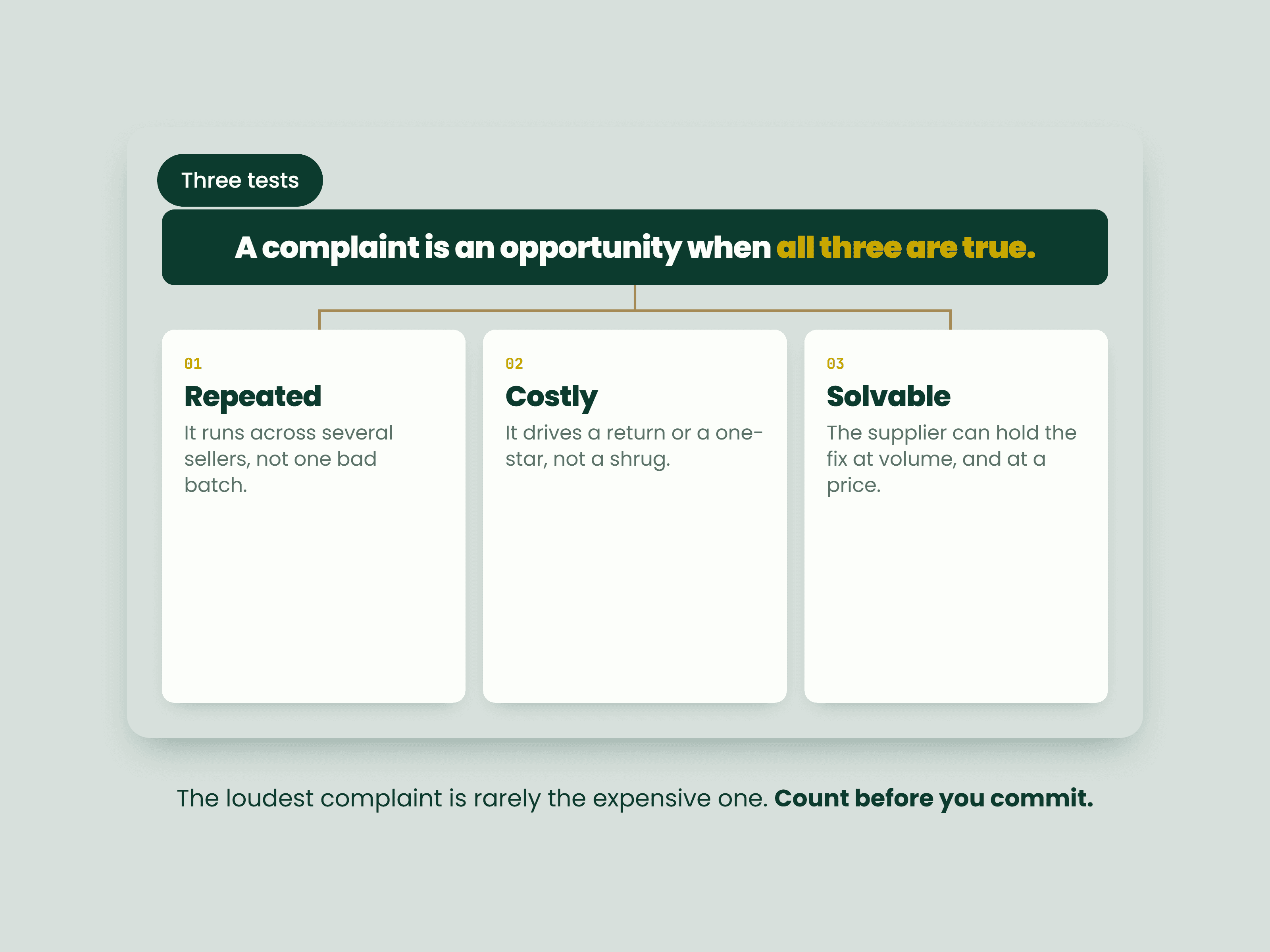
A single bad review is not an opportunity. Three things have to be true at once.
Repeated. It appears across multiple sellers in the category, not just one, and not clustered in a single month. A problem in one brand's reviews is a manufacturing batch. The same problem in four brands' reviews is a category-level failure, and category-level failures are what you can actually take.
Costly. It drives a return, a one-star, or a decision not to buy again. Some complaints are real and cheap. Colour slightly off from the photo is real, appears often, and almost nobody returns over it. That is a photography fix, not a product opportunity.
Solvable. Your supplier can fix it, hold it consistently at volume, and at a landed cost the category's price band can absorb. A fix that adds four dollars to a unit in a market where the ceiling is nineteen is not a fix.
Run every candidate problem through the three. Packaging arriving crushed: repeated, moderately costly, very solvable, so it goes near the top. Breaks after two weeks: less frequent, severe, and solvable only if the failure is a component rather than the whole design, so it is worth a call with the factory before it goes on the list. Hard to clean: repeated, moderately costly, usually solvable, and frequently ignored because it never shows up in a keyword tool.
The loudest complaint and the expensive one are rarely the same complaint. Count before you commit.
Turn customer language into a product requirement
This is the step that decides whether any of the reading was worth doing, and it is the one that most often gets skipped by one move.
Someone writes: the handle keeps slipping out of my hand.
The reflex is to put "ergonomic handle" in the bullets. That is customer language going straight into marketing copy, which changes nothing about the product and sets up a review that says the ergonomic handle still slips.
The translation you want is a requirement a factory can be held to:
The handle must maintain grip when wet.
Another. Someone writes: the container leaks when I throw it in my bag.
Not "leak-proof lid" on the listing. The requirement is:
The seal must hold under movement and lateral pressure, not only when upright and static.
That distinction is the difference between a specification and an adjective. One can be tested before production. The other can only be contradicted after it.
The chain is: customer language, then the underlying problem, then the requirement. Not customer language straight to listing copy.
Validate the problem before you change the specification
Before the specification changes, go back to the people you are building for and ask two questions.
If a product solved this, would it matter to you?
And the one that decides it:
Would you pay more for it?
The gap between those answers is where launches die. People will happily agree that a problem is annoying. Far fewer will pay four dollars more to have it removed, and the ones who will are not always the ones who complained loudest. A complaint is evidence that something is wrong. It is not evidence that anyone will fund the fix.
Interviews, surveys, concept tests, prototype feedback and simulated shopping tests all answer this, and all of them cost a fraction of a purchase order. This step exists to stop you building a solution to a problem people are willing to discuss but not willing to buy.
The sequence, and why the order is the whole argument
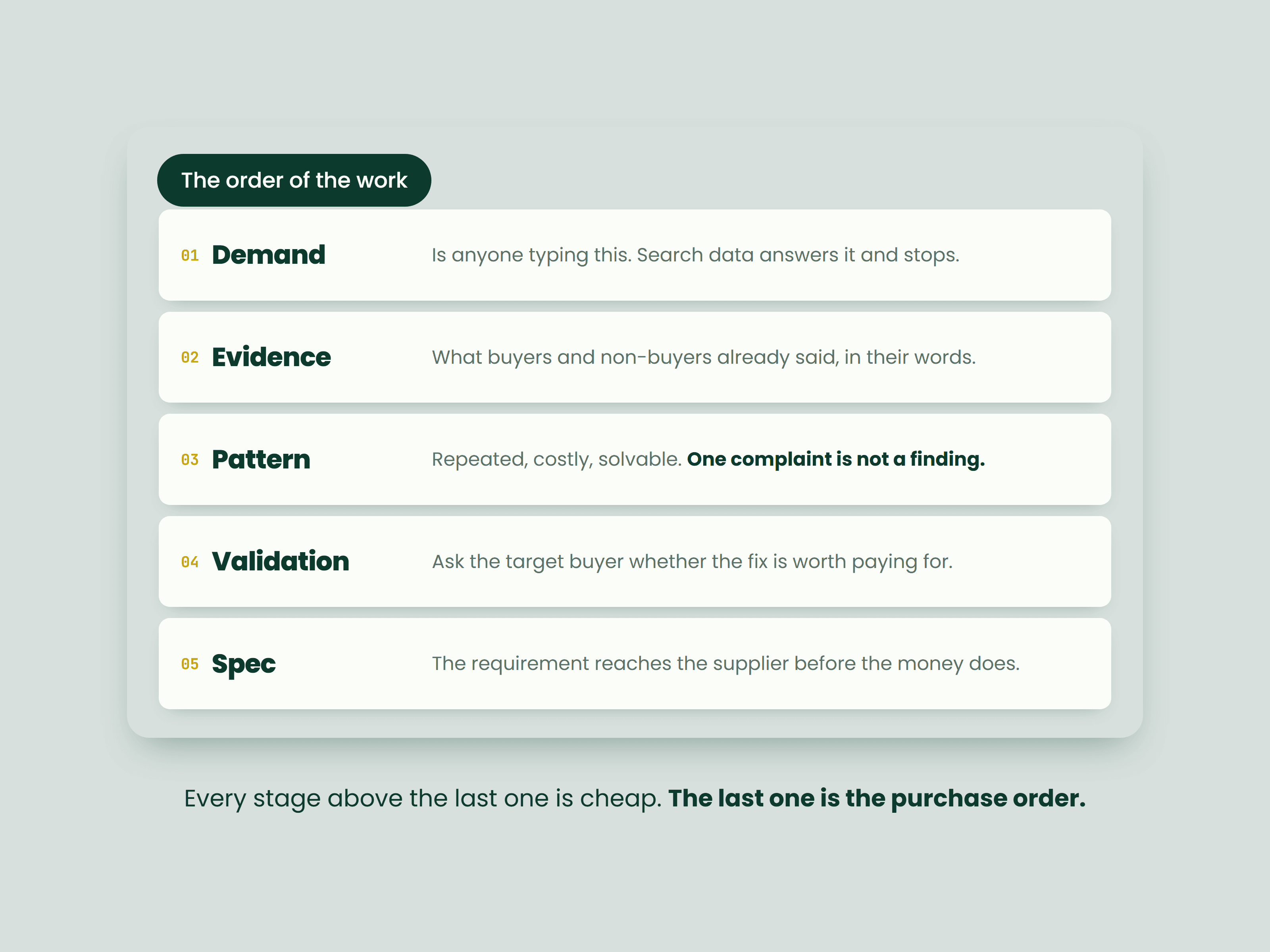
The old order:
Keyword, competitor, differentiation, product.
The better order:
Demand, customer evidence, problem, pattern check, validation with real buyers, product opportunity, specification, positioning, listing.
It is longer, and every stage before the last two is cheap. Reading reviews costs an evening. Opening Product Opportunity Explorer costs nothing. Twenty conversations cost a few hundred dollars. The purchase order costs everything, and in the old sequence it is the fourth step.
Nothing in the second list replaces keyword research. Demand is still stage one, because a problem nobody is searching for is a hobby. The change is that demand stops being the finish line and becomes the entry condition.
When customer research changes the product
[SECTION HELD. A real example goes here before this post is published.]
Changing a specification is cheap. Changing a listing to apologise for a specification is not, and it does not work.
The checklist before you approve a product
Demand
Is there enough of it
Is it stable, or was last year a spike
Is it seasonal, and can you fund the dead months
Customer
What are people actually buying this for
What frustrates them about what they own now
What complaint repeats across several sellers
What do they say they wish existed
Competition
What are the incumbents genuinely good at
Where do they fail, in their own reviews
Which complaints appear across all of them rather than one
Product
Can the problem actually be solved
Can the supplier hold the fix at volume, not just on the sample
Does the improvement matter enough for someone to pay for it
Economics
What does the improvement add to landed cost
Can the category's price band carry that
Does the differentiation improve the margin or quietly destroy it
The last question in that list is the one that ends the exercise. A differentiation that customers want and the price band cannot fund is not an opportunity. It is a more expensive way to lose.
What each kind of research is actually buying you
Keyword data buys you permission to look. It tells you the market is real, roughly how big, and what to call the thing.
Customer evidence buys you the decision. Which problem inside that market to spend the money solving, which requirement goes to the supplier, and which one of the eleven possible improvements is the one people will pay for.
Run in that order, the research is a filter on capital. Run backwards, it is a post-mortem.
Do not build the product and then research the customer. Research the market, understand the customer, find the problem, check that anyone will pay to have it removed, and then commit the inventory.
Considering a product for launch? Send me the opportunity you are looking at. I will tell you what I would investigate before the specification gets locked, across demand, the competitive set, the customer problems already visible in the category, and whether the economics survive the differentiation.
FAQ
Is keyword research still worth doing for Amazon product research?
Yes, and it is still stage one. It is the cheapest way to find out whether a market exists and how people refer to it, and no amount of customer insight rescues a product nobody searches for. The argument here is about what happens after demand is confirmed, not about skipping the step.
Where do I find customer complaints for products I do not sell?
Reviews and customer questions on competitor listings, plus Product Opportunity Explorer's Customer Review Insights panel, which aggregates review themes across a whole niche and shows how each theme affects the star rating. Return reasons are not available for other sellers' products. Voice of the Customer only reports on your own catalogue.
How many reviews should I read before I trust a pattern?
There is no threshold worth quoting, and anyone giving you one is guessing. What matters is spread rather than count: the same problem appearing across several different sellers, over more than one quarter, is a category problem. Forty reviews on one listing can all be about a single bad production run.
Can I ask people in a forum or a Facebook group to leave me a review?
No. Reading public conversation is fine and always has been. Soliciting reviews from it breaks Amazon's Community Guidelines on incentivised and manipulated reviews, and the consequences land on your selling account, not on the group.
Does Product Opportunity Explorer need Brand Registry?
Search Query Performance does, because it sits in Brand Analytics. For Product Opportunity Explorer, check the Growth menu in your own Seller Central rather than trusting a blog on it, this one included. Access conditions change and are worth confirming on the account you will actually be using.
What if the customer research says the opportunity is not there?
Then it did its job, at roughly the cost of a week. That outcome has no case study written about it and it is the highest-return result in this entire process, because the alternative was finding out the same thing three months later with the inventory already paid for.
I already launched. Is this useful?
Yes, with the sources reversed. You now have return reasons, your own Voice of the Customer data and your own reviews, which is better evidence than any pre-launch research produces. It informs version two, the variation you add next, and which complaint to fix first.
SOURCES
Onieque Edwards
Content Strategist /Blog Writer
Onieque is the brain behind bold Amazon growth strategies and structured business execution. He enjoys turning scattered ideas into clear, actionable systems that actually drive results. When he’s not building out growth plans or refining campaigns, you’ll likely find him exploring new coffee spots or getting lost in ideas that connect strategy with creativity.