← Back to Blogs
Amazon Strategy
13 min read
Amazon Product Research Before Ordering Inventory: Why Reviews Cannot Tell You If It Will Sell

Onieque Edwards
Content Strategist /Blog Writer

Amazon Product Research Before Ordering Inventory: Why Reviews Cannot Tell You If It Will Sell
You are about to approve a purchase order. Three thousand units, your own money, twelve weeks before a single one can be sold. And the thing you are reading to make that call is a column of star ratings on somebody else's listing.
Reviews are the most available research an Amazon seller has. Free, right there on the page, and they read like customers talking. They are also written by a group of people selected in a way that guarantees they cannot answer the question you are asking.
Why reviews will not tell you if a product will sell
A review is written after the money has already moved. Everything else about it follows from that.
To leave one, a person had to find the listing, believe it enough to click, be convinced enough to buy, wait for delivery, use the product, and then care enough to go back and type. Every one of those steps removes people. The shopper who read the page and closed the tab left nothing. The one who found the price too high left nothing anywhere.
That is survivor bias. The sample you can see is made up entirely of people who survived the purchase decision, and the decision is the thing you are trying to predict.
A second filter sits on top. Among people who did buy, the ones who write are mostly the ones who liked it enough to bother or were annoyed enough to bother. The quiet middle, usually most of the buyers, says nothing. The star average is a poll of the two ends.
The concession is worth making plainly, because a peer will make it for you. Reviews answer one question well: for people who already bought this, did it work. No forum thread answers that as well. It is just a different question from the one before a purchase order, which is whether people who have bought nothing yet will buy this.
Amazon is splitting review sharing across variations in 2026, and the rating you are reading will move
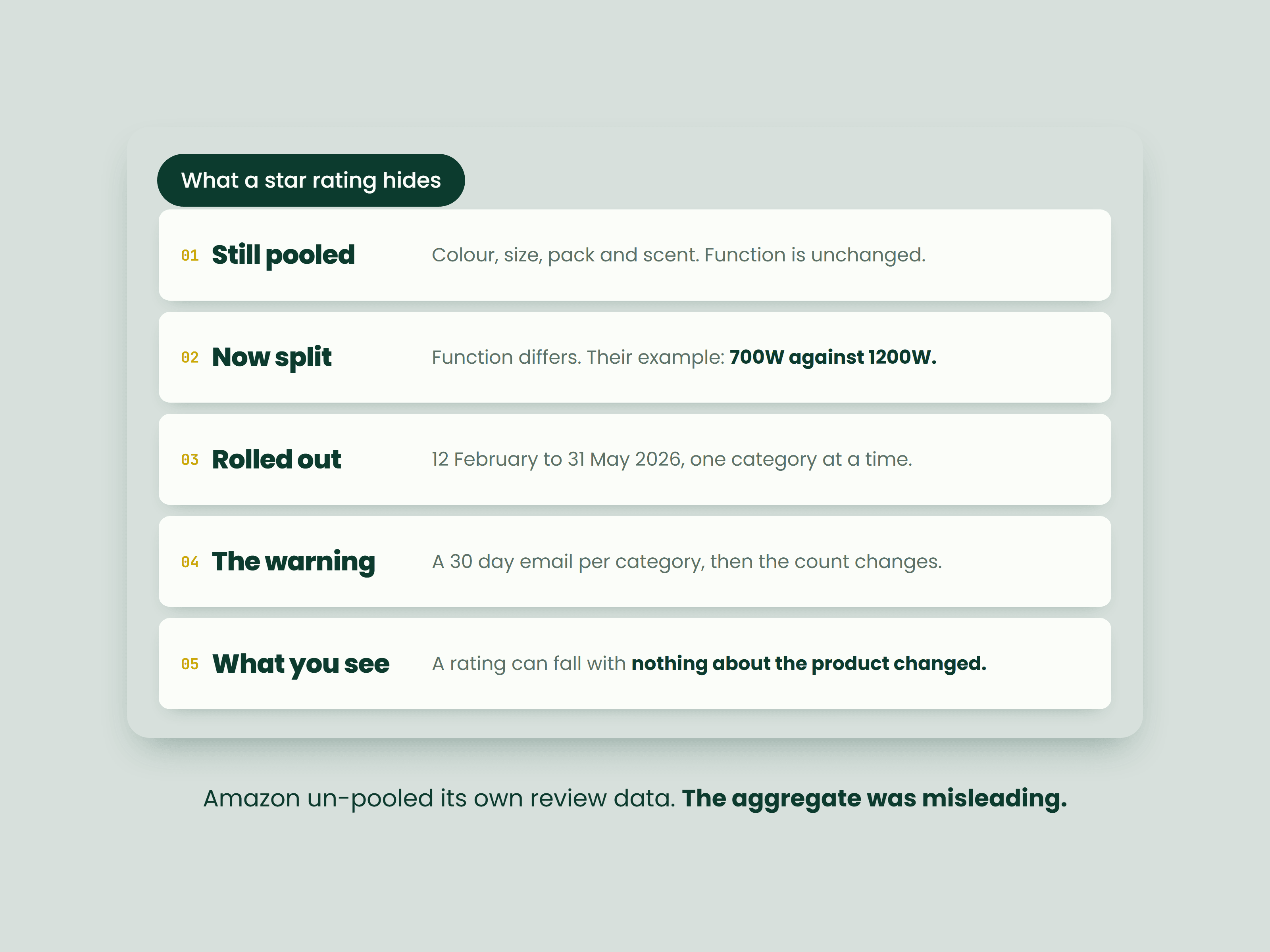
If you want a second opinion on how much weight a pooled star rating deserves, the platform publishing it has already given one.
On 7 January 2026 Amazon announced through the Seller Forums that reviews will stop pooling across variations that differ materially in function, corroborated by MyAmazonGuy and Cahoot. Rollout began 12 February 2026 and runs category by category through 31 May 2026, with a 30-day advance email to sellers in each affected category.
What keeps sharing: variations differing only in colour, pattern, size where function is preserved, pack size, scent, or fitment. What splits: variations that differ in function. Amazon's own example is a 700W microwave under the same parent as a 1200W one. Parent and child structure is unaffected. Only the pooled rating and review count change, so each child ASIN carries its own number.
Read that back slowly. The most visible number on any product page, the one every product research habit starts with, is being taken apart by the company that publishes it, on the grounds that a shared rating was misleading shoppers. And when the split reaches a category, some sellers will watch their visible rating drop with nothing having changed about the product, because it was being propped up by a better-performing sibling the whole time. A number that can move that much for that reason was never a stable read on quality.
Amazon's 2025 Trustworthy Shopping Experience Report says it blocked hundreds of millions of suspected fake reviews last year. That is an absolute count, not a rate, and Amazon publishes no rate at all, so treat any fake-review percentage you see quoted as unverified.
What Amazon Vine actually costs, and what a Vine review is
The other reason a young listing's rating is hard to read is Vine.
Vine is Amazon's program for getting early reviews on a product that has none. It requires a Professional Seller account plus Brand Registry, and for branded products a Brand Representative or Reseller role tied to the enrolled brand. Enrollment is per parent ASIN and tiered. Current as of 2026 vendor reporting rather than an Amazon help page fetched for this article, the tiers run up to 2 units free, 3 to 10 units at $75, and 11 to 30 units at $200. The fee is flat regardless of how many enrolled units get reviewed, so enrolling 30 and receiving 12 reviews still costs the $200 tier. Sellers are charged only after the first Vine review publishes, and if none publishes within 90 days there is no charge at all. Mechanics per BellaVix and SalesDuo.
Vine reviews carry a "Vine Customer Review of Free Product" label and can be positive, neutral or negative. Amazon guarantees nothing about the sentiment.
What Vine reviewers are not is a random sample of your buyers. They received the product free and opted into a program that exists to review things, and research on it consistently finds a mild positivity skew. Vine reviews also run longer and get more specific about individual attributes than the average organic review. I am not going to give you a star-rating gap between Vine and organic, because the sources that publish one contradict each other and none traces back to a dataset anyone can check. So a competitor's early rating is often part-composed of reviews from people who did not pay for the product.
Why "just read Reddit instead" does not fix the problem
The obvious next move is to go where people talk before they buy. Reddit threads, YouTube comments, the question someone types at eleven at night about whether the thing they are considering has the problem they are worried about. Nobody is paid to post that. It is the objection in its natural state, and reviews cannot contain it. It is also its own biased sample, and pretending otherwise swaps one blind spot for another.
The published research on social listening is not kind to the assumption that online conversation represents a market. Studies caution that opinions drawn from social platforms are skewed by vocal minorities, a warning that appears in practitioner literature as the vocal minority problem and in market research writing as the risk that social listening works as an echo chamber rather than a survey.
The mechanism is a double self-selection. First, who is on the platform at all, which is not the population that shops a category on Amazon. Second, who posts in the thread, which skews hard toward people with an unusually strong feeling about it. A subreddit for a product category is a room of enthusiasts and people with a grievance, not a room of median buyers, and the median buyer is who your first three thousand units are for.
So forum language is not a better predictor of Amazon sales than reviews. That claim does not survive the evidence. It is a different kind of signal, showing you what reviews are incapable of showing you.
Where to check real demand before you order: Search Query Performance and purchase share
Both sources above are opinions. There is a third input that is a count, and it lives inside Seller Central.
Search Query Performance is a report in Brand Analytics, under the Brands menu, and it requires Brand Registry. For a given search term it reports the whole funnel: impressions, clicks, cart adds and purchases. Then your share of each step.
Purchase share is the one to understand first. It is the percentage of all purchases made from that search term across Amazon that went to your ASIN. Not your conversion rate, not your click share. Your slice of every purchase the term produced. Helium 10 and MyAmazonGuy describe the same screen and columns.
Run it against a close competitor's category terms before you commit and it stops being a keyword tool and starts being a pre-launch check, because it tells you where the purchases on that term land right now and how tightly they are held. A term with big volume where purchase share spreads across a dozen sellers is an open market. A term with the same volume where two incumbents take most of the purchases has already been won, and search volume alone would have told you those two were identical opportunities.
Four sources, four different questions
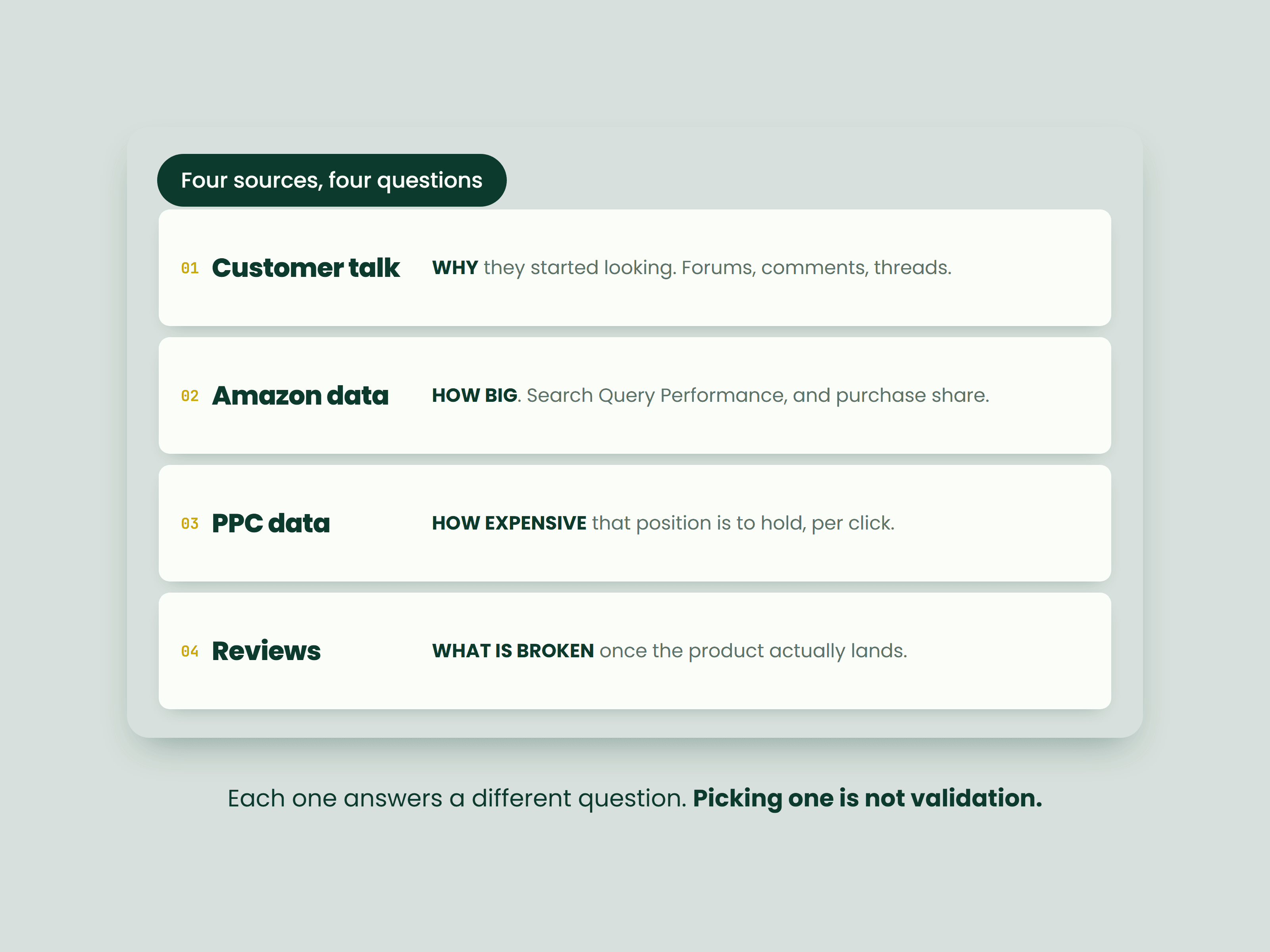
No single one of these is product research. Each answers a question the others cannot.
Reviews answer whether the product works for people who bought it. Biased toward buyers who kept it and toward the two ends of the sentiment range. Good for failure modes and language, unreliable as a market signal.
Pre-purchase language in forums and comment threads answers what stopped people and what they compared it against. Biased toward the vocal, unrepresentative of the median shopper. Good for finding the objection, unreliable as a size estimate.
Search Query Performance answers whether the demand is real and who is collecting it. Not an opinion at all, and gated behind Brand Registry. Good for sizing and winnability, silent on product quality.
Unit economics answer whether a sale at that price, after landed cost, fees and the click it takes to win the shopper, leaves you anything. The one people skip, and the only one denominated in money.
Read alone, each produces a confident wrong answer. Read against each other, each corrects what the next one hides. One flag is noise. Correlated flags are a finding.
What pre-launch research connects to: ad cost, keyword concentration, and the size of your first order
This is where a research question turns into three financial ones.
Purchase share sets your cost per click before you have spent a cent. Cost per click is what you pay each time a shopper clicks a sponsored placement. When purchase share on a term sits with one or two incumbents, those sellers hold the conversion history and organic position that make the term cheap for them and expensive for everyone else. Entering there means paying a premium click price to buy attention off people paying less than you for the same shopper. Knowable in advance, and invisible if your research stopped at search volume.
A complaint that clusters on one use case can hide keyword concentration risk. Keyword concentration is the degree to which a product's revenue depends on a small number of search terms. If the pre-purchase language you found is all about one failure of one competitor, and demand for that exact complaint traces back to a narrow set of terms, the market that looked large in a keyword tool hangs on one phrase. A ranking change on that phrase is not a bad week. It is the business.
And the size of the first order is a bet on the reliability of the number you sized it from. Ordering three thousand units against a competitor's 4.6-star rating, when that rating was pooled across variations Amazon is about to split or was part-assembled from free-product reviews, commits real cash against a number that was never stable. Inventory is the least reversible decision in the sequence. It deserves the most stable input, and the star average is the least stable one available.
Reading public posts is fine. Recruiting reviews from them is not
Reading public posts for insight is fine. No terms of service is violated by a seller reading a Reddit thread about a product category.
Messaging people from that thread to ask for a review, offering anything in exchange for one, or pointing people from a forum toward your listing to leave one, crosses Amazon's review manipulation policy and puts the selling account at risk. Since October 2024 it is separately a federal matter. The FTC's rule banning fake reviews and testimonials was announced on 14 August 2024, published in the Federal Register on 22 August 2024, and took effect on 21 October 2024, with civil penalties up to $51,744 per violation.
Read the room. Do not recruit from it.
What your first inventory order and your first ad dollar are actually buying
Two cheques get signed. Product research exists to price them.
The first inventory order buys a position in a category you decided was winnable. If purchase share on the terms that matter is already concentrated, that cheque buys the right to compete for the leftovers at a premium click price, and the units accrue storage fees while you find out. If the share is open, the same cheque buys a position that gets cheaper to hold every month.
The first ad dollar buys either discovery or displacement. Discovery is cheap and compounds. Displacement is expensive and has to be paid again every month you want the ground, because an incumbent's conversion history does not disappear because you outbid them on a Tuesday.
A star rating cannot tell you which of those you are buying. It was written by people who had already decided, about a product they already owned, and Amazon is reorganising it this year on the grounds that it was misleading anyway.
So the decision is not which product to launch. It is how much of your capital is allowed to depend on a market someone else already owns, and that number belongs on the table before the purchase order, not after it.
If you want that read run properly on a category before you commit inventory, that is one of the things a full account and category audit pulls apart. You keep the numbers either way.
FAQ
How do I know if a product will sell before I order inventory?
Not from the star rating on a competitor's listing, because it is written entirely by people who already bought and mostly kept the product. Use four inputs together: reviews for how the product fails in practice, pre-purchase forum and comment language for the objection people had before buying, Search Query Performance in Brand Analytics for whether the demand is real and who is collecting it, and your own unit economics for whether a sale at that price leaves anything after fees and click costs.
Should I trust 5-star reviews on Amazon?
Trust them for what they are, which is feedback from people who completed a purchase and had a strong enough feeling to type. They cannot show you anyone who considered the product and walked away, and that group is who decides whether your launch works. Amazon itself began splitting pooled ratings across functionally different variations on 12 February 2026, on the grounds that a shared rating was misleading shoppers.
What is purchase share in Search Query Performance?
It is the percentage of all purchases made from a given search term across Amazon that went to your ASIN. It is not your conversion rate and not your click share. It tells you where the purchases on that term currently land, which is what separates a searched term from a winnable one. The report sits under Brands, then Brand Analytics, then Search Query Performance, and requires Brand Registry.
Does Amazon Vine make a product's rating look better than it is?
Vine reviews come from people who received the product free through Amazon's program, and research on the program consistently finds a mild positivity skew, though reviews can be positive, neutral or negative and carry a "Vine Customer Review of Free Product" label on the page. There is no reliable published star-rating gap between Vine and organic reviews, so treat it as a reason to read the review text rather than count the stars, not as a fixed adjustment to apply.
How much does Amazon Vine cost in 2026?
Enrollment is per parent ASIN and tiered, and as reported by vendor sources in 2026 it runs up to 2 units free, 3 to 10 units at $75, and 11 to 30 units at $200. The fee is flat regardless of how many enrolled units get reviewed, is charged only after the first Vine review publishes, and is not charged at all if none publishes within 90 days. It requires a Professional Seller account plus Brand Registry.
Can I ask people on Reddit to review my Amazon product?
No. Reading public posts for research is fine. Messaging people to request a review, offering anything in exchange for one, or directing people from a forum to your listing to leave one breaches Amazon's review manipulation policy and risks the selling account. Since 21 October 2024 it is separately a federal matter under the FTC's fake reviews rule, with civil penalties up to $51,744 per violation.
Is Reddit better than reviews for Amazon product research?
No, and the claim does not survive the evidence. Published research on social listening finds online conversation skewed toward a vocal minority that self-selects twice, first by who is on the platform and then by who posts in the thread, with no guarantee the demographic matches Amazon buyers. Forum language shows you a different kind of signal, the objection before the purchase, which reviews structurally cannot contain. Neither one is research on its own.
SOURCES
Primary (Amazon and federal sources)
About Amazon, Trustworthy Shopping Experience Report 2025 — absolute counts of blocked fake reviews, sites shut down, and bad actors pursued. No rate is published.
FTC — Final Rule Banning Fake Reviews and Testimonials, 14 Aug 2024
Federal Register — Trade Regulation Rule on the Use of Consumer Reviews and Testimonials, 22 Aug 2024 — effective 21 October 2024, penalties up to $51,744 per violation.
Trade press and practitioner sources (cross-checked, no disagreement)
ppc.land — Amazon splits variation reviews, reporting the 7 January 2026 Seller Forums announcement.
MyAmazonGuy — Amazon Product Variation Review Sharing Update
Vendor sources, flagged as such in the body
Social listening bias
Checked and excluded
Every circulating fake-review percentage. The most widely repeated one traces to a December 2023 analysis by a delivery-software company, run on Fakespot's detection engine. Fakespot was shut down by Mozilla in 2025, so the number can never be re-run or verified. No figure of that kind appears in this article.
Any Vine-versus-organic star-rating delta. Sources contradict each other in both directions with no traceable dataset behind any figure.
The Stanley cup, Owala and protein-powder discussion threads. Real and findable, but no dated study compares pre-purchase to post-purchase language for any of them, so no claim is attached to them here.
Any client result or account number. `content/jp-proof-bank.md` is thin, so the article carries none.
Any bridge from this topic to buy box or ad-serving mechanics. Those are post-launch operational levers and the connection would have been invented.
Onieque Edwards
Content Strategist /Blog Writer
Onieque is the brain behind bold Amazon growth strategies and structured business execution. He enjoys turning scattered ideas into clear, actionable systems that actually drive results. When he’s not building out growth plans or refining campaigns, you’ll likely find him exploring new coffee spots or getting lost in ideas that connect strategy with creativity.