← Back to Blogs
Amazon PPC
15 min read
Your Best Amazon Search Terms Are Stuck In The Campaign That Found Them

Onieque Edwards
Content Strategist /Blog Writer
Your Best Amazon Search Terms Are Stuck In The Campaign That Found Them
Most of the accounts I audit do not have a keyword problem. They have a harvesting problem, and from the outside those two look identical.
A keyword problem means the account has not found the terms that work yet. A harvesting problem means it found them, printed them in a report, and left them sitting inside the campaign that discovered them.
The second one costs more, because the expensive part is already finished and already paid for.
The shape of it is always the same. A customer search term has five orders against it. Or eight. Or fifteen. It is converting. And it is still inside an auto campaign, or matched loosely by a broad keyword, drawing from a daily budget it shares with hundreds of other targets, at a bid that was set for the group rather than for it, under a placement adjustment chosen with something else in mind.
Amazon has already answered the expensive question there. People who type this buy yours. The account has not answered the cheap one, which is what to do about it.
What a discovery campaign is for
Automatic, broad and phrase targeting are instruments for finding out. That is the whole design.
Amazon describes automatic targeting in four groups, and the language is worth noticing. Close match: "We may show your ad to shoppers who use search terms closely related to your products." Loose match: the same sentence with loosely in it. Substitutes and complements do the same thing on product pages. Every one of them is a sentence about maybe.
Then Amazon says what the output is for: "By using metrics from the automatic campaign search term report, you can gain insight on the best keywords or products to target for your manual targeting campaign."
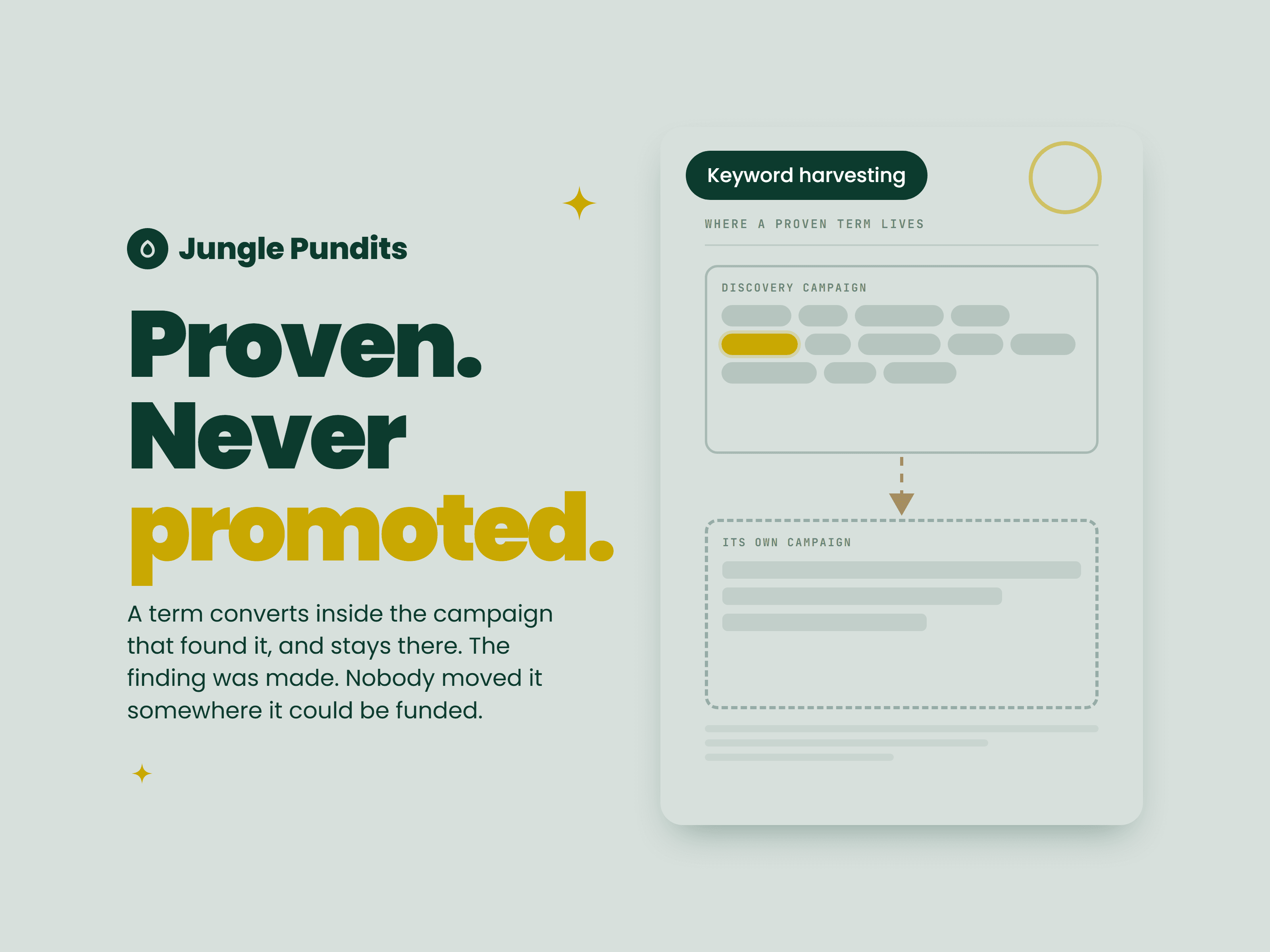
There is a direction in that sentence. The auto campaign is the input. The manual campaign is where its findings are supposed to end up. A large number of accounts run the input permanently and never build the output.
A discovery campaign has a job with an end to it. On a given query, that job finishes the moment the query proves it converts. Every pound spent on that query afterwards is being spent at a bid and inside a budget chosen for a different purpose, which is a fair description of waste even when the sales keep arriving.
The report that shows it, and the one that does not
Two advertising reports get used interchangeably here, and they answer different questions.
The search term report shows the shopping terms customers actually typed that led to at least one click on your ad. Amazon says it can be used "to identify high-performing customer searches that can be added as new keywords, or add under-performing search terms as negative keywords." That is the harvesting report, and it is the only one that contains the shopper's own words.
The targeting report shows the keyword or product target you bid on. Impressions, clicks, orders and spend, attached to the thing you chose rather than to the thing the shopper typed.
For harvesting you need the first one, because what you are looking for does not exist in the second. For judging a keyword you have already promoted, you want the second one, because there the four numbers all belong to a single target. A promoted exact keyword still matches close variants such as plurals and common misspellings, so even after promotion the search term rows underneath it and the keyword row above it are not the same number, and reading one as if it were the other is how people reach confident conclusions about keywords that are really conclusions about aggregation.
One more report sits behind both of these and settles arguments neither can. Search Query Performance, in Brand Analytics, carries the whole market funnel for a query and your share at each step. It needs Brand Registry, so not every seller can produce it, but where it exists it tells you whether a term you are about to fund is one you are already winning quietly or one you have barely touched. That is a different article. For harvesting, the advertising search term report is enough to act on.
What "it converted" actually proves
Five orders is a real thing. It is not automatically a mandate.
The count on its own is the weakest part of the evidence. What carries more is whether those orders are spread across weeks or stacked into one afternoon, and whether the weeks in question were ordinary. A term that produced eight orders during a seven-day deal, or during a fortnight when the category leader was out of stock, has told you about that fortnight.
There is no published order count that makes a term safe to promote, and every number in circulation traces back to somebody's own account rather than to a measurement of the marketplace. The honest test is whether you would put money on the next hundred clicks behaving like the last hundred. On a high-volume term that confidence arrives quickly. On a slow one it can take a season, and promoting early on a slow term is how a campaign ends up with a budget it cannot spend and a conclusion drawn from four clicks a week.
Two other things belong in the same check. Whether the orders came from one child ASIN or several, because a term that converts for one size and not the others belongs in that ASIN's campaign and nowhere wider. And whether anything unusual was running, a coupon, a discount, a competitor gap, because those raise conversion on every term at once and then end.
Six things to check before you promote a term
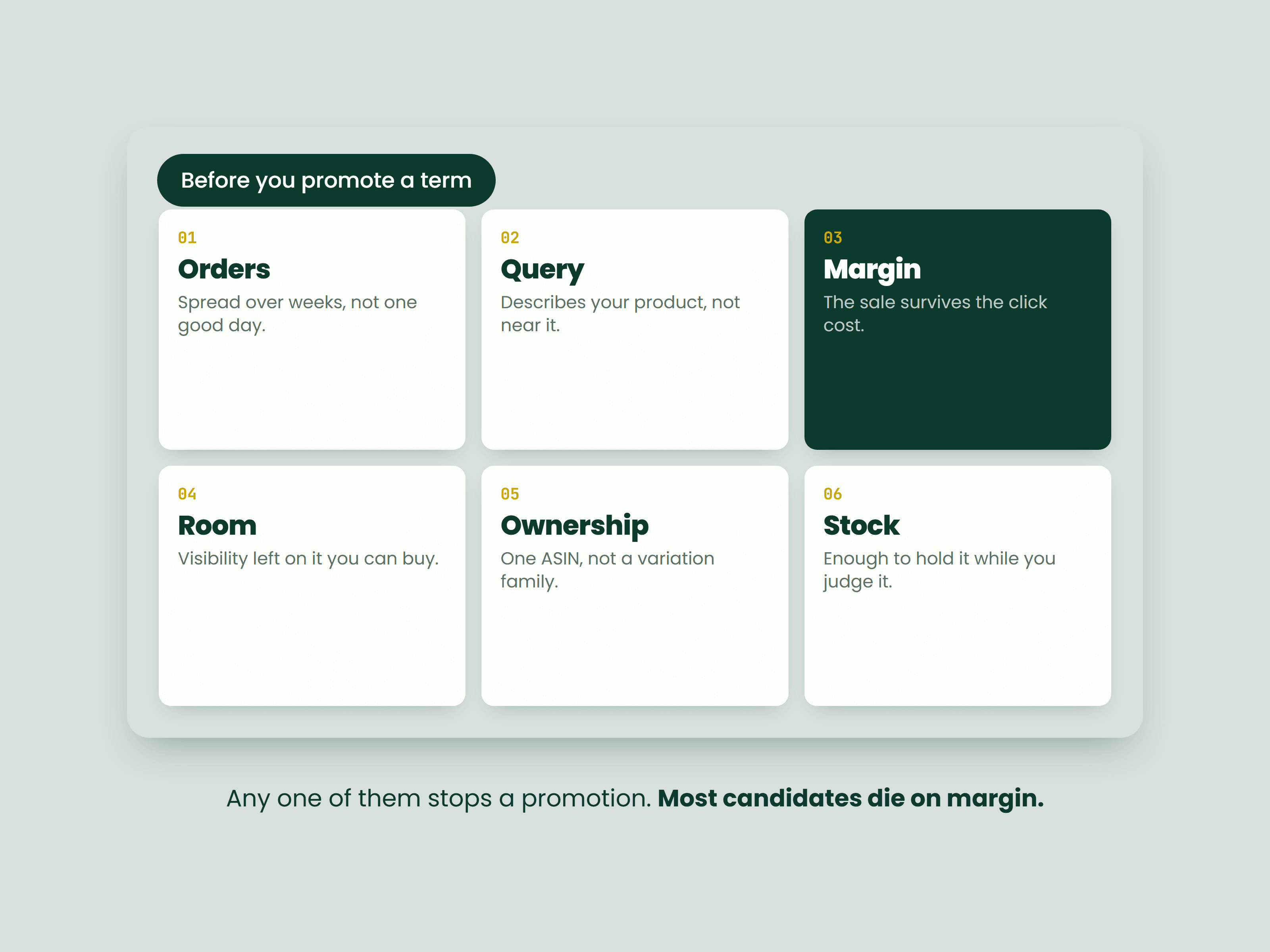
Orders. Enough of them, spread over enough time, that the pattern is not one good week wearing a disguise.
Query. The words have to describe your product rather than sit near it. A term that converts occasionally because your listing is an acceptable second choice will get much more expensive the moment you bid on it directly, because you will start winning the impressions you were previously only catching.
Margin. What the sale keeps after the click. A term you win at a cost per click your margin cannot carry is a term worth knowing about and not worth funding, and that is a legitimate outcome of this check rather than a failure of it.
Room. Whether there is visibility left to buy. If you are already taking most of the impressions available on that query, moving it into its own campaign changes the reporting and the control but it does not buy you much more of the query, and the budget will do more somewhere with a gap in it.
Ownership. Whether the term belongs to one ASIN or to a family. Promoting a term into a campaign holding every variation spreads it across children that never converted on it.
Stock. Whether the ASIN can take the extra volume for the length of time it takes to judge the move. Funding a term into a stockout buys you a gap in the data and a rank you then have to rebuild.
Any one of these can stop a promotion on its own, and the order above is roughly the order in which they kill candidates.
What its own campaign actually buys
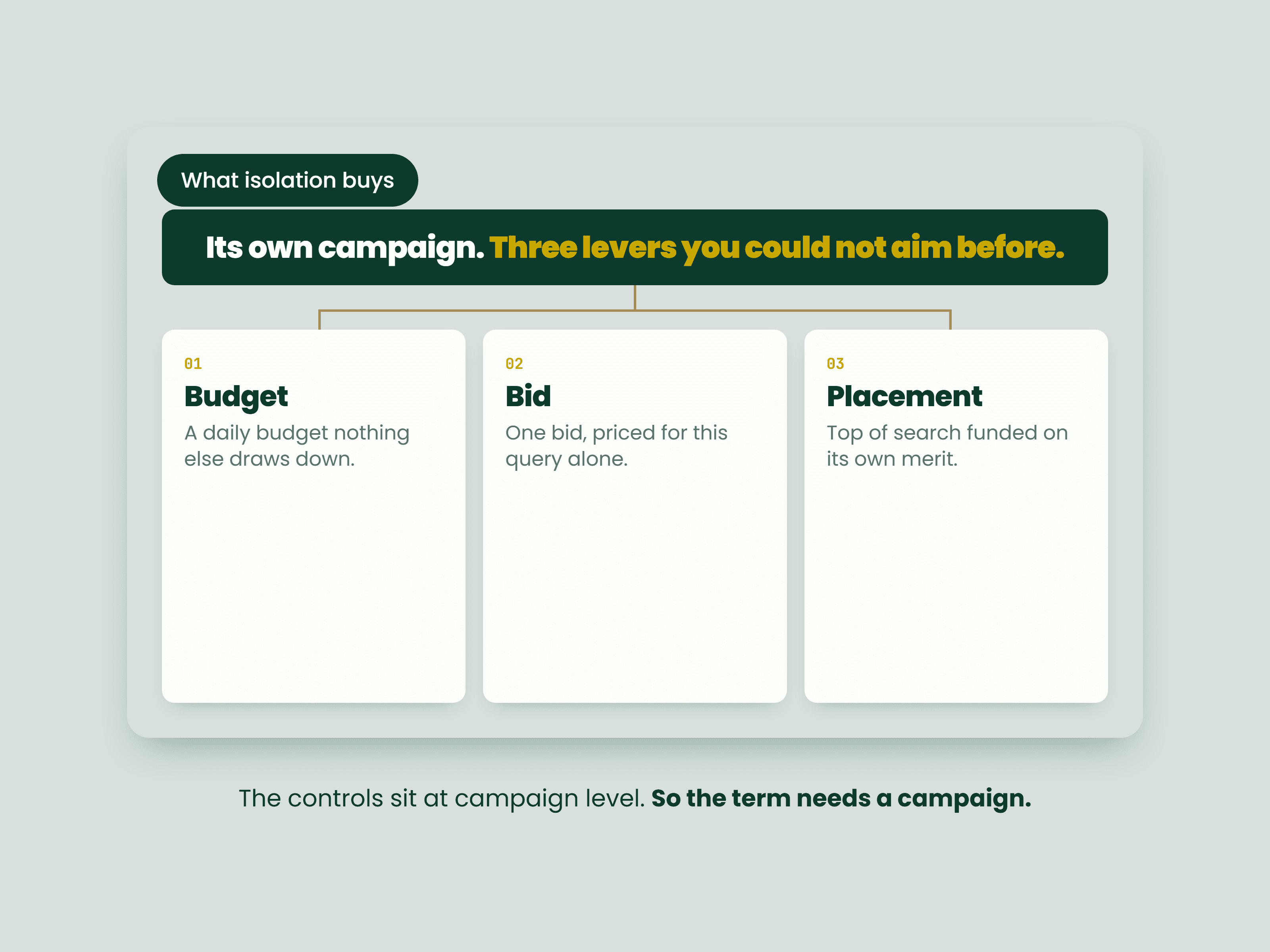
This is the part that makes harvesting worth doing rather than a filing exercise. The levers that matter on Amazon sit at campaign level, and a lever at campaign level cannot be pointed at one search term while that term is one of hundreds inside the campaign.
A budget that is only this term's. Daily budget is a campaign setting. Amazon averages it across the calendar month and may spend up to 25% more than the average on a given day, which is useful, but the arithmetic only helps a term that has a budget of its own. Inside a shared campaign the term is competing for spend with every other target in it, and on the days the campaign runs out early, what stopped serving is decided by the auction rather than by you.
A bid set for this query. One bid, chosen against what a click on this specific term is worth given its conversion rate and your margin, instead of a bid that has to be a reasonable compromise across everything the campaign matches.
A placement adjustment aimed at one query. Top of search, rest of search and product pages can each carry a bid adjustment of up to 900%, set per campaign. A term that converts well at the top of search and poorly beside a competitor's product page can be funded accordingly, but only if it is not sharing that setting with targets that behave the other way round.
And then the match type itself. Amazon says exact match, where the search term is matched word for word, "tends to result in the highest conversion rates" of the three. Broad match "may include singulars, plurals, variations, synonyms, and related terms", which is exactly the behaviour you want while you are still looking and exactly the behaviour you stop wanting once you have found something.
None of these is an optimisation. They are the controls, and until the term has a campaign they are pointed somewhere else.
The claim that gets repeated, and what is actually documented
The usual reason given for this move is that your broad campaign is stealing traffic from your exact campaign, that you are bidding against yourself, and that your own cost per click is being driven up by the fight.
Some of that is not documented and should not be stated as though it were. Amazon does not publish a rule about how its auction resolves the case where several of your own campaigns could match the same query. The claim circulates widely, in several incompatible versions, and none of them traces back to Amazon.
What can be said without inventing anything is narrower and enough on its own. When more than one of your campaigns can match a query, you do not get to choose which one does. Whichever campaign serves it, that campaign's bid applies, that campaign's budget pays, that campaign's placement adjustment is in force, and the sale is attributed there. So a term you believe you have promoted can go on being served by the campaign you promoted it out of, at the old bid, out of the old budget, while the new campaign sits underspent and looks like it failed.
The fix is the same either way. The reason you give for it should still be true, because the version that names a self-inflicted price war invites the obvious follow-up question and does not survive it.
The half of the move nobody finishes
Adding the term to an exact campaign is half a promotion. The other half is stopping the old campaign from continuing to serve it.
Add the harvested term as a negative exact in the campaign that found it. That blocks that specific string, and its close variants, from matching there while leaving the campaign free to go on finding other things, which is its job.
Resist reaching for negative phrase here. Negative phrase blocks every query containing the phrase in that order, which will also block the longer, more specific variants of the term that you have not harvested yet and that are often the better ones. A negative phrase is the right tool for a family of queries that is wholly wrong for you, not for a term you have just decided is good.
A promotion without the negative is the most common half-finished version of this work, and it is worse than not doing it at all, because the account now has two places the term can serve from, a new campaign whose numbers are incomplete, and an old campaign whose numbers are still being credited with a decision somebody thinks they already made.
Where the money is supposed to come from
A promotion is a budget decision before it is anything else.
If the new exact campaign is funded with new money, total spend went up and nothing was reallocated. Sometimes that is right. But the argument for harvesting is not that your account should spend more, it is that your account is already spending on this term at the wrong price in the wrong place, and the spend should follow the term.
So the discovery campaign should get smaller. Not to nothing, because it still has a job, but by roughly what the promoted term was consuming inside it. A discovery campaign whose budget has been the same figure for a year is telling you one of two things: nothing is being harvested out of it, or things are being harvested and nobody has ever taken the money back.
That second case is the quiet one. The account looks organised. There are exact campaigns with sensible names. And total spend has been climbing for a year, because every promotion added a campaign and no promotion ever subtracted a budget.
When not to promote a term at all
A competitor's brand name. Bidding on one is a strategic decision with its own economics, its own conversion profile and its own reasons to be wrong. It is not a harvest, and folding it in with one hides the decision.
A term that only converted during an event. Note it, wait for an ordinary period, look again.
A term whose margin does not survive its click cost. Knowing it converts is worth having. Funding it is not.
A term that converts through a bundle or a multipack you are not certain you will keep listing. You are about to build a campaign on a product decision that has not been made.
A term you cannot service. Low stock, a long lead time, or a supplier you are mid-switch on.
How to run the check
1. Pull the search term report for Sponsored Products across a window long enough that a slow term has had a fair chance, and treat that window as fixed rather than adjusting it until the answer looks better.
2. Filter to rows with at least one order. Everything else in this pass is noise, and the zero-order rows with real spend are a separate job, which is negatives.
3. Sort by orders. Read spend beside them, not instead of them.
4. For each candidate, check the six above. Most will die on margin or on ownership.
5. Build the exact campaign, or add to an existing exact campaign that shares its theme, with its own budget, its own bid and its own placement adjustments.
6. Add the term as a negative exact in the campaign that found it. Same day, not next week.
7. Reduce the source campaign's budget by roughly what the term was taking out of it.
8. Leave it alone long enough to accumulate a readable sample. The failure here is moving budget, reading a partial week, and moving it back, which produces two changes and no clean result between them.
9. Judge the promoted term in the targeting report, where the numbers belong to one target, rather than in the search term report where they are spread across variants.
Weekly is more than most catalogues need. Every two weeks is usually enough, and the first two or three months after a launch produce far more candidates than any period after that.
The decision underneath all of this
Discovery is a cost you pay once per term. A term that stays in discovery is a cost you pay every month for information you already have.
That is the whole thing, and it is a budget argument rather than a keyword one. The question is not which keyword to add next. It is whether your discovery budget is buying new information or re-buying the same information at a price you set before you knew the answer.
Every account has a figure for this, and almost nobody has looked at it. Take the terms in your search term report that have converted repeatedly and are still living inside auto or broad, and add up what was spent on them last month. That number is what the account paid to be told something it already knew. It is usually larger than the amount anybody is arguing about in the budget conversation, and unlike most of the levers in an ad account, moving it does not require a single additional pound.
A brand that harvests is not spending more. It is spending the same money at prices it chose, on terms its own customers already validated, in campaigns it can actually steer. A brand that does not harvest is running a permanent research project on questions it answered months ago, and paying the research rate for the answers.
If you want to know which of your search terms have already proven themselves and what they are costing you where they sit, that is what the audit does.
FAQ
What is keyword harvesting in Amazon PPC?
Taking a customer search term that has converted inside an automatic, broad or phrase campaign and giving it its own targeted keyword, usually exact match, in a campaign where you control its budget, its bid and its placements. The discovery campaign finds the term. Harvesting is the step that moves the finding somewhere you can act on it. Amazon's own guidance points this direction, describing the automatic campaign's search term report as the way to work out what to target in a manual campaign.
How many orders does a search term need before I move it to exact match?
There is no published number and any specific figure you are given comes from somebody's account rather than from a measurement of the market. What matters more than the count is whether the orders are spread across weeks rather than concentrated in one promotional period, and whether you would expect the next hundred clicks to behave like the last hundred. On a high-volume term that becomes clear quickly. On a slow term it can take months, and promoting early there leaves you judging a campaign on a handful of clicks a week.
Should I add a negative keyword after moving a search term to exact match?
Yes, as a negative exact in the campaign the term came from, on the same day. Without it the old campaign can go on serving that query at its old bid out of its old budget, the sale is attributed there, and the new campaign looks underspent and unsuccessful when nothing was actually wrong with it. Use negative exact rather than negative phrase, because a negative phrase also blocks the longer variants of the term that you have not examined yet.
Will my broad and exact campaigns compete against each other if I do not add negatives?
Amazon does not publish how its auction resolves a query that several of your own campaigns could match, so treat any confident description of a bidding war with yourself as unsourced. What is certain is that you cannot choose which campaign serves it, and whichever one does, its bid, budget, placement adjustment and attribution are the ones that apply. That is reason enough to make the query available in exactly one place.
Should I use phrase or exact when I promote a term?
Exact, when the point is to control and fund one specific query, which is the situation harvesting creates. Amazon describes exact as matching the search term word for word and says it tends to produce the highest conversion rates of the three match types. Phrase is worth keeping where you have found a promising root and suspect there are longer variants of it still to discover, in which case it is doing a discovery job rather than a funding one, and it should be treated and budgeted as such.
How often should I run this?
Every week or two is enough for most catalogues, and a launch is the exception. The first months of an auto campaign on a new product generate far more candidates than any comparable period later, both terms to harvest and terms to negate. After that the report settles down and a fortnightly pass will catch what appears, as long as somebody is also checking that the discovery budget is shrinking as things are taken out of it.
SOURCES
Onieque Edwards
Content Strategist /Blog Writer
Onieque is the brain behind bold Amazon growth strategies and structured business execution. He enjoys turning scattered ideas into clear, actionable systems that actually drive results. When he’s not building out growth plans or refining campaigns, you’ll likely find him exploring new coffee spots or getting lost in ideas that connect strategy with creativity.