← Back to Blogs
Amazon News
8 min read
Why Did Amazon Change My Product Title? The 75-Character Rule, Explained

Onieque Edwards
Content Strategist /Blog Writer
Why Did Amazon Change My Product Title? The 75-Character Rule, Explained
You opened a listing you have not touched in months and the title is shorter. Words you put there are gone. Nothing was suppressed, nothing was flagged, and there is no email you can find that told you it was coming.
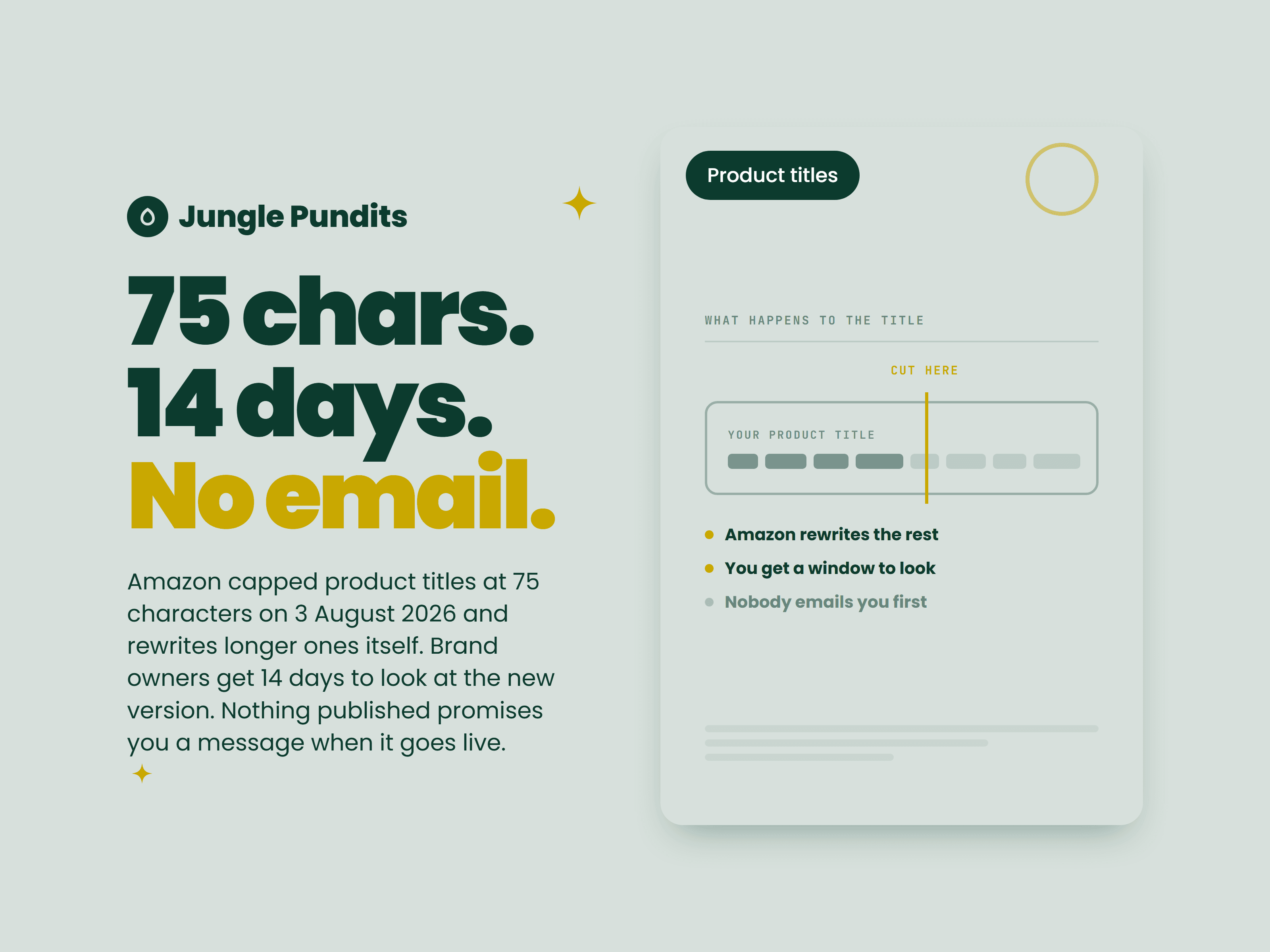
That is not a glitch. On 3 August 2026 Amazon began enforcing a 75-character cap on product titles, and titles still over the cap are being rewritten by Amazon's AI. Your listing stayed active through all of it, which is exactly why it is easy to miss.
Here is what changed, who gets a say in it, and the part most coverage of this policy gets wrong.
What actually changed to Amazon product titles on 3 August 2026
Product titles are capped at 75 characters, including spaces, across all product types except media. The previous cap was 200.
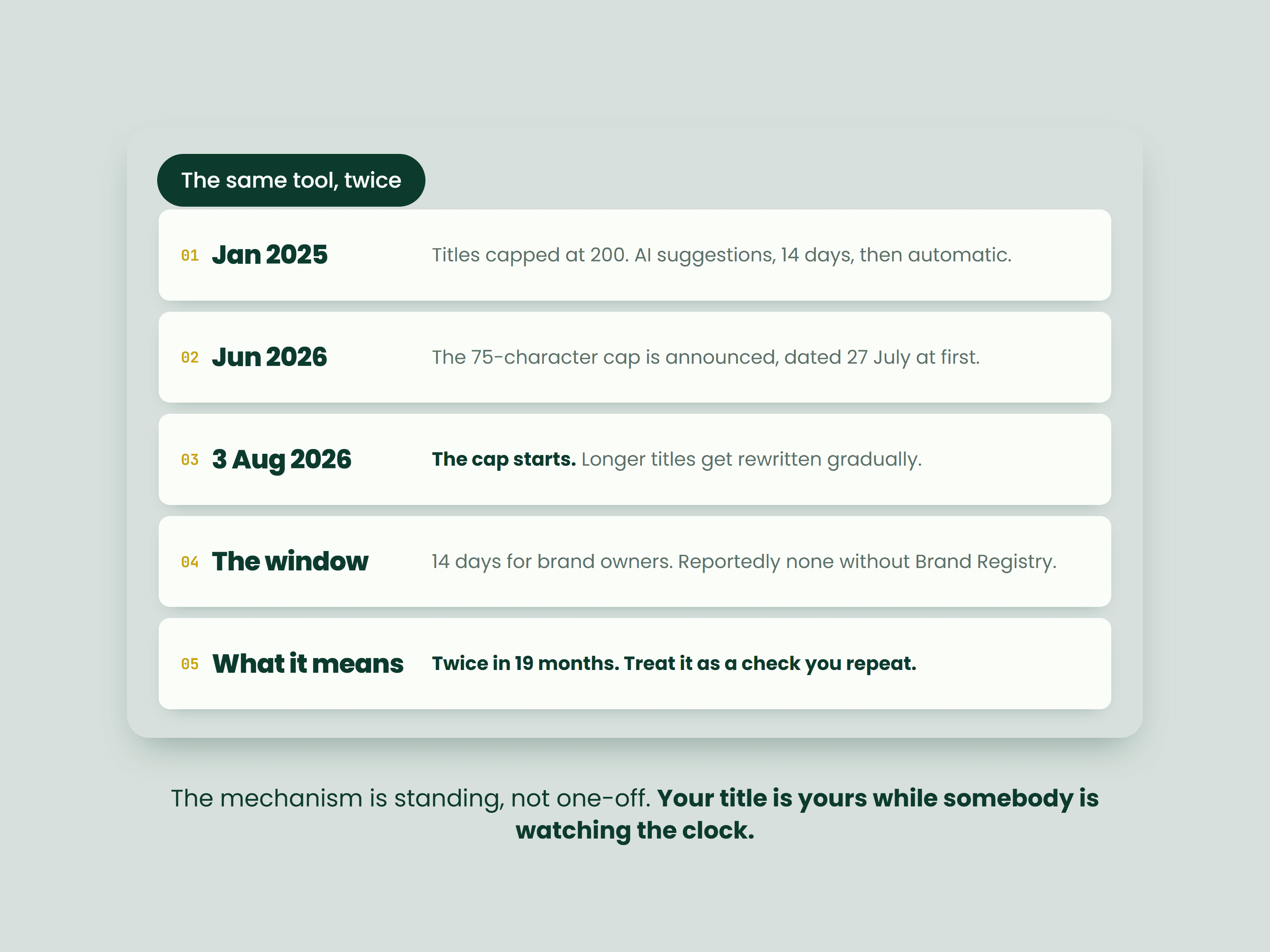
Amazon announced this in June 2026 with a start date of 27 July, then moved the date to 3 August (EcommerceBytes, 7 August 2026). If you have been searching for the July date and finding nothing, that is why.
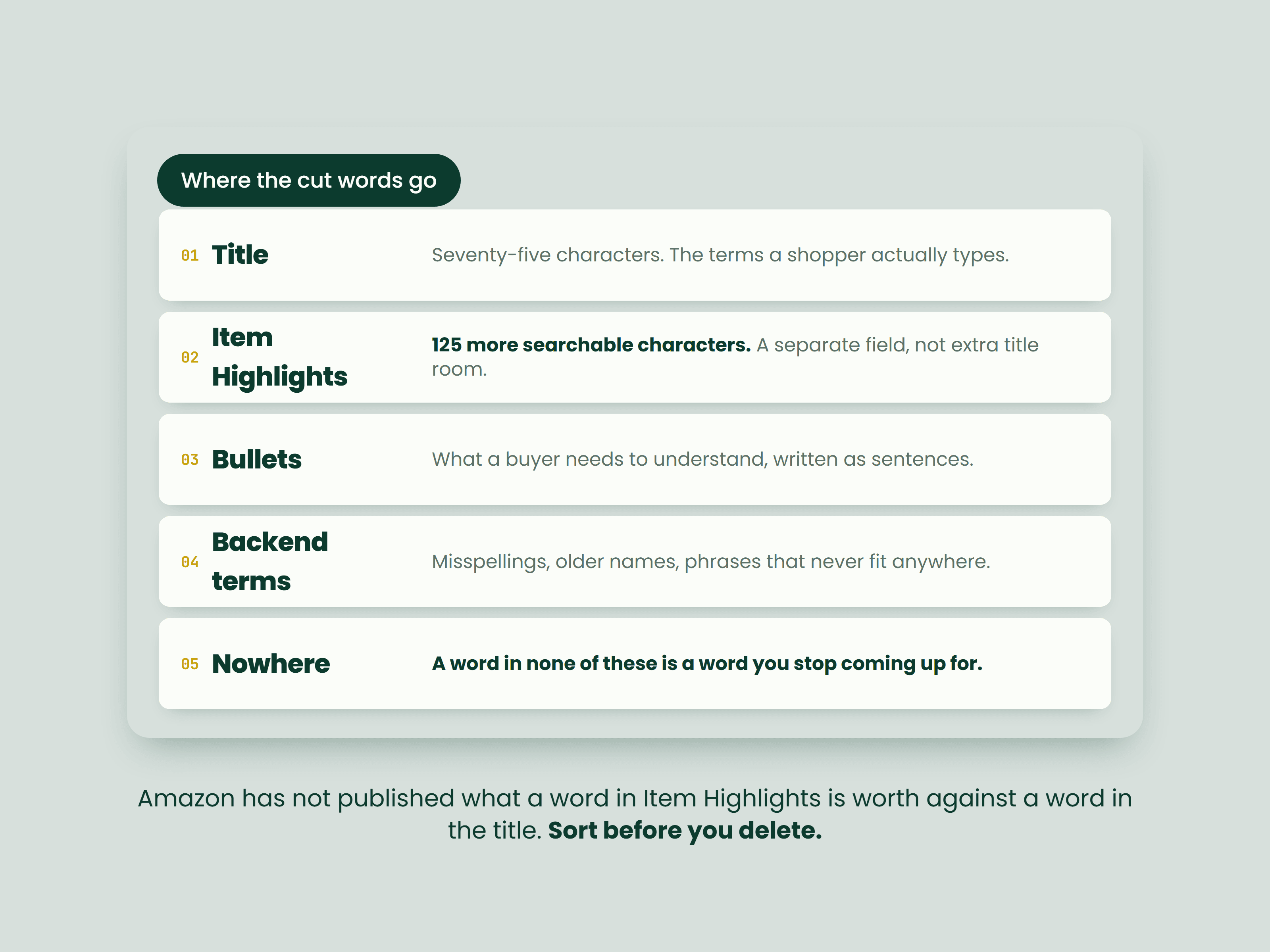
The overflow has somewhere to go. A field called Item Highlights carries an additional 125 searchable characters. Total searchable space around the title is roughly where it was. What moved is who decides which words sit in which field.
Two details that keep getting buried. Amazon reported over 984 million product titles updated since the announcement, which is Amazon's own figure repeated by outlets citing Amazon rather than an independently audited count. And the policy covers Amazon's own retail listings, confirmed by a moderator answering a seller directly on the Seller Forums: "This policy applies to Amazon listings as well" (via EcommerceBytes, 7 August 2026).
If you are reading this before your titles have been touched, the pre-deadline guide covers the rewrite itself. This piece is about what is running now that the deadline has passed.
Who gets 14 days in Review Listing Changes, and who gets nothing
The rewrite is not instant. Amazon's own wording is that titles still over 75 characters "will be updated to the AI recommendation gradually."
Brand owners get a review step. It lives in a tool called Review Listing Changes, under Manage Your Products in Seller Central. A suggested title appears there and you have 14 days to review it, modify it, or approve it. Do nothing for 14 days and it applies itself.
Sellers without Brand Registry reportedly get no review window at all, with Amazon applying the rewrite directly. That detail is repeated consistently across secondary summaries of Amazon's announcement rather than confirmed at the primary help-page level, so treat it as reported rather than settled. If it holds, it is the sharpest line in the whole story. It turns Brand Registry from a trademark-protection question into the only thing standing between an unregistered seller and a silent rewrite.
Look at how that clock is built. Silence is consent. A seller who took two weeks off in August has already answered.
This is the second time Amazon has rewritten product titles this way
Worth knowing before you file this under one-off policy change.
In January 2025 Amazon tightened title requirements to a 200-character cap and enforced it with the same machinery: an AI-suggested correction, a 14-day brand-owner review window, then automatic application if nobody responded. Same tool, same clock, different number.
The mechanism has now fired twice in nineteen months. That changes the advice. "Set your title once and it is stable" was already wrong in January 2025 and it is more wrong now. The accurate model for 2026 forward is that the title field is yours only while somebody is watching a specific screen inside a specific 14-day window. The same Review Listing Changes tool is used for broader attribute suggestions that Amazon's AI generates on product pages, so titles are one instance of a habit rather than the whole of it. Amazon has done something structurally similar with default-on AI ad creative, and the pattern is the same: the default runs unless you go and change it.
What a shorter title does to your Sponsored Products ads
This is where most articles on this policy overreach, so let me separate what is confirmed from what is not.
First, one term, said plainly once. Indexing is Amazon deciding which search terms your listing is eligible to appear for. The title is one of the fields it reads to make that call. Your bullets, your backend search terms and your description are others. When people say a listing is indexed for a keyword, they mean Amazon treats the listing as a candidate when someone types it.
What is confirmed. Amazon's own Sponsored Products documentation names relevance as a factor in ad serving alongside your bid and campaign settings, and states that the system analyses your product details, including titles, to display your ads for relevant shopping queries. That is Amazon Ads help content, not a forum rumour.
What is not confirmed, and I want to be plain about it. No dated seller report ties this rollout to a measured change in ad serving. I went looking for one specifically. The threads about impressions falling off are generic ads-troubleshooting threads with no connection to this policy, and the one vendor article that comes closest predates the August rollout and names no sellers and no dates. Anyone telling you sellers are already reporting ad drops from this rewrite is telling you something they cannot show you.
Amazon also does not publish whether Item Highlights carries the same keyword weight as the title. ppc.land put it exactly right on 10 June 2026: it is "not publicly documented at this level of granularity." A keyword moved from the title into Item Highlights is still sitting in a searchable field. Whether it is worth the same there is a question Amazon has not answered, and nobody outside Amazon can answer it for you.
So the honest framing is a mechanism and a blind spot, not an observed trend.
The title sits on both sides of the account. It is buyer-facing copy, and it is one of the fields Amazon reads to decide relevance. That makes a title change a listing event with an advertising consequence, and nothing in Seller Central carries that signal from the catalog side across to the ad side. Your campaigns do not get notified when your listing's title changed. There is no shared alert, because catalog and advertising are treated as separate accounts by every screen you have.
One more connection that gets missed. Organic rank and ad relevance are the same signal seen twice here, not two separate problems. A seller who checks "is my ad still running" and never checks "am I still ranking for that term" is reading half of it. The search term report is where a change in what your campaigns are actually winning impressions on would surface. Open it as the report that would tell you, not as a report that has told anyone anything yet.
Why the Q4 calendar makes the timing expensive
A quiet title rewrite in February is an annoyance. The same rewrite landing now sits directly on top of the year's revenue.
Prime Big Deal Days run 7 and 8 October 2026, and the deal submission deadline is 8 September. Black Friday and Cyber Monday fall on 27 and 30 November. Amazon's recommended FBA arrival window for holiday inventory sits in late October, and the published summaries of Amazon's July announcement round that cutoff slightly differently, so check the exact date against Amazon's own notice rather than a blog before you book freight. The peak fulfilment surcharge window runs 15 October 2026 to 14 January 2027.
Now put the two clocks beside each other. A 14-day silent-consent window, rolling gradually across a catalog, in the weeks where deal submissions close and inventory has to be on the water. A title you did not choose does not cost the same in August as it does in November, and it compounds in the direction of your best weeks.
Which keywords deserve your 75 characters
Here is the decision underneath all of this, and it is not a formatting decision.
You have 75 characters of the most visible copy on your listing, and 125 characters in a field whose weight Amazon has not disclosed. Every term you protect in the title is a term you are choosing to defend with your most valuable space. Every term you move down is a term you are choosing to fund some other way, and the other way is usually ad spend.
That is a budget question wearing a copywriting costume. A term you hold organically in the title costs you nothing per click. The same term demoted, if the demotion costs you relevance, gets bought back at whatever the going cost per click is in your category, every day, for as long as you sell the product. Choosing which four or five terms earn the title is choosing which parts of your demand you own outright and which parts you rent.
Gut feel is a poor way to make that call, and letting a 14-day clock make it is worse. The inputs that make it answerable are already yours: which terms actually convert, which ones you rank for without paying, which ones your ads are carrying on their own, and what each would cost to buy back if it slipped. Those sit across your search term report, your organic positions and the listing itself, and no single screen in Seller Central puts them next to each other.
A title rewrite you approved after reading all four is a decision. A title rewrite that applied itself on day 15 is a decision too. It just was not yours.
Not sure which terms earned your 75 characters?
If the ones that got demoted were carrying your organic rank, that is what the audit reads. Catalog and ad account together, so a title change gets checked against what your campaigns are still winning impressions on instead of being looked at on its own.
Sources
Amazon's New Product Title Policy Also Applies to Its Own Listings, EcommerceBytes, 2026-08-07
Amazon to Use AI to Enforce New Product Title Limits, EcommerceBytes, 2026-06-11
Amazon Seller Forums, the official product title update Q and A thread
Amazon cuts product title limit to 75 characters on July 27, ppc.land, 2026-06-10
New product title requirements effective January 21, 2025, Amazon Seller Forums
Review Listing Changes Tool: Your Guide to Managing AI Product Updates, Amazon Seller Forums
Amazon Publishes Q4 2026 Deadlines: Same Fees, Earlier Inventory Cutoffs, ecomcrew
Amazon Signals Holiday Peak: 2026 Fulfillment Fees Begin October 15, gain.consulting
Onieque Edwards
Content Strategist /Blog Writer
Onieque is the brain behind bold Amazon growth strategies and structured business execution. He enjoys turning scattered ideas into clear, actionable systems that actually drive results. When he’s not building out growth plans or refining campaigns, you’ll likely find him exploring new coffee spots or getting lost in ideas that connect strategy with creativity.