Amazon's New 75-Character Title Limit: What FBA Sellers Must Do Before July 27
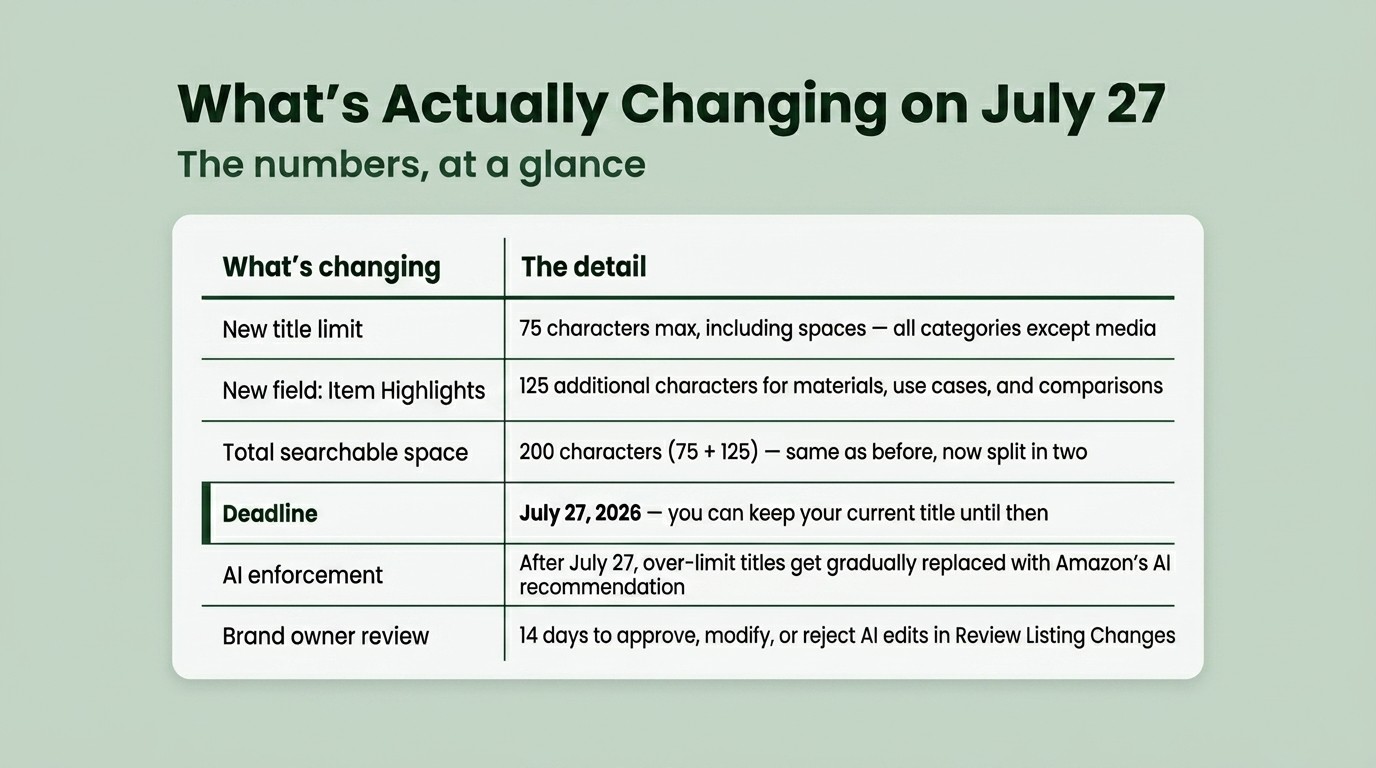
On July 27, 2026, Amazon stops letting you control your own product title past 75 characters and if yours runs long, an AI will rewrite it for you. The keywords you spent months ranking for could disappear from your title without your sign-off, and you'll only find out when your rankings move. This isn't a soft "recommendation." It's a hard cap with an enforcement mechanism behind it. Titles in every category except media must fit inside 75 characters, including spaces. For context: the old limit was 200. Amazon is cutting your title field by more than half and handing the overflow to a new field and to its own AI.
The reason is mobile. Most of your customers shop on a phone, where a long title gets truncated mid-sentence anyway. Amazon wants the visible part of your title to be the part you'd actually choose. The intent is reasonable. The execution is where sellers get hurt.
Here's exactly what's changing, what's at stake if you wait, and how to rewrite your titles so the right keywords survive.
The part everyone misses: your total space didn't shrink
Read the table again. You go from 200 characters of title to 75 characters of title plus 125 characters of Item Highlights. That's still 200 characters of searchable, indexable real estate Amazon has confirmed Item Highlights content is searchable and appears alongside titles in search results and on product pages.
So the panic on the forums "I'm losing 125 characters of keywords!" is mostly wrong. You're not losing the space. You're losing the freedom to decide what goes where. And as we'll cover below, that distinction is the entire ballgame.
Why Amazon is doing this
Three drivers, all pointing the same direction:
Mobile-first display. A 75-character title shows in full on a phone screen. Long titles truncate, so the back half of your keyword stuffing was never being read by humans anyway.
Consistency with other retailers. Amazon wants its titles to look like the clean, scannable titles shoppers see on other major storefronts.
Less keyword stuffing. By splitting titles and highlights, Amazon pushes attributes and use cases out of the title and into a structured field cleaner titles, same searchability.
What happens if you do nothing
Your listing stays active. That's the good news, and it's the news Amazon leads with.
Here's the rest of it. After July 27, any title still over 75 characters gets replaced gradually with Amazon's AI-generated version. The machine reads your existing title, decides which words matter, trims to 75 characters, and pushes the rest to Item Highlights. It does this without your product knowledge, your margin priorities, or your understanding of which keyword actually drives your conversions.
You wake up one morning and your hero keyword is now sitting in Item Highlights instead of your title. Your listing is still live. Your ranking just shifted. And you didn't choose any of it.
That's the cost of waiting: you trade a one-time editing task now for a slow, invisible erosion of control later.
The real risk most sellers are missing
The character count is the obvious problem. It's also the easy one shortening a title is a formatting task. The risk that actually moves revenue is subtler, and it comes in two parts.
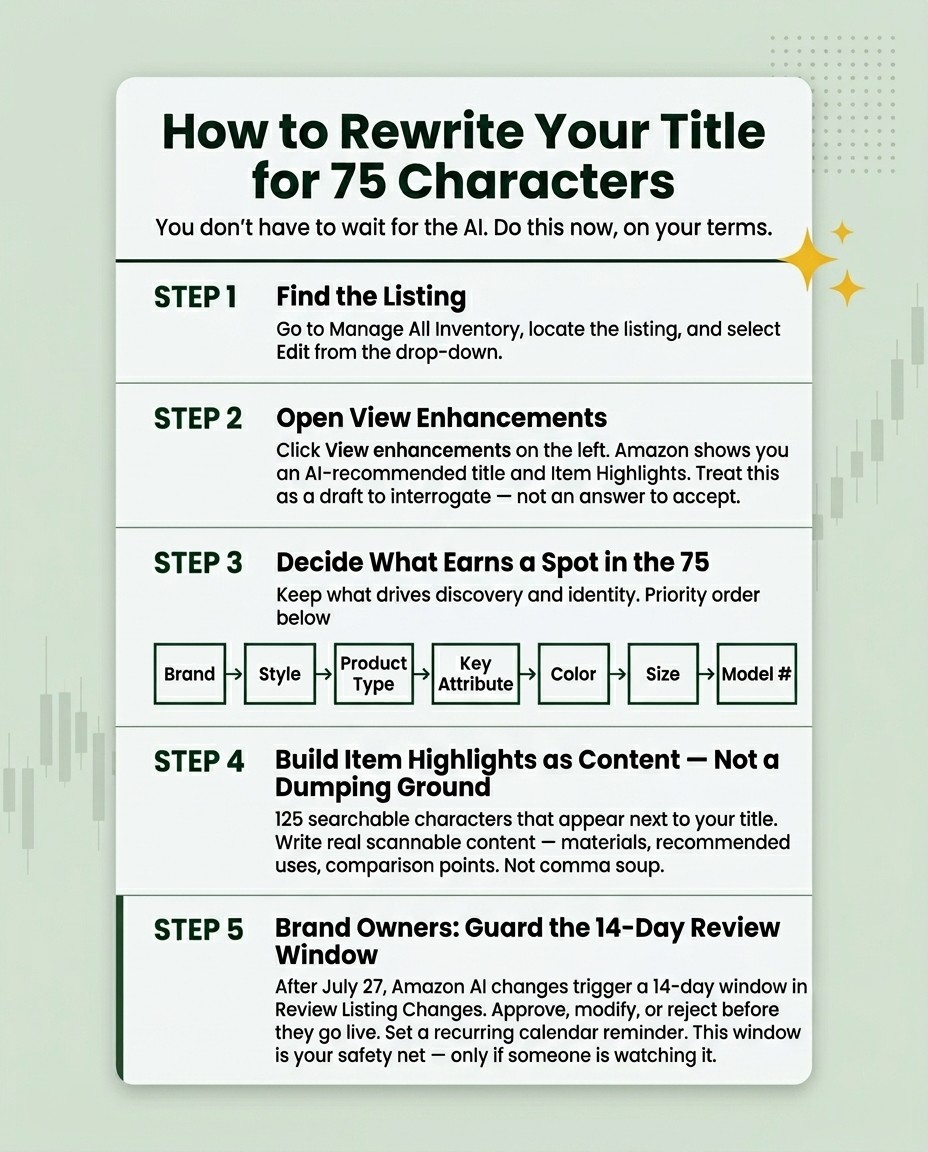
First: the AI decides your keyword priority. Because total searchable space is unchanged, the question is no longer "which keywords do I keep?" It's "which keywords earn the high-value 75-character slot, and which get demoted to Item Highlights?" Title placement has historically carried weight in how listings surface. When you let the AI auto-rewrite, you're handing that prioritization decision to a system that doesn't know your account's data. The keyword you rank #3 for might be exactly the one it moves out of the title.
Second: the listing still signals what your product is in words you didn't choose. Amazon's compliance systems read your visible listing, not your intentions. If an AI rewrite introduces a phrasing that trips a category or compliance signal, that's now on your listing, written by a machine, under your account. Aligning your title and Item Highlights yourself in your words, with your judgment keeps you in control of both the ranking and the risk.
This is the difference between treating July 27 as a formatting deadline and treating it as a catalog-strategy decision. The first is a chore. The second is where rankings are won or lost. (This is the moment a focused audit pays for itself knowing which keywords to defend in the 75 is account-specific work, not a template.)
Two worked examples (before → after)
Example A — a kitchen tool
Before (≈160 chars): Premium Stainless Steel Garlic Press with Soft Ergonomic Handle, Easy to Clean Dishwasher Safe Mincer Crusher for Ginger Nuts, Heavy Duty Professional Kitchen Gadget
After — Title (66 chars): ChefGrip Stainless Steel Garlic Press – Ergonomic, Dishwasher Safe
After — Item Highlights (≈115 chars): Crushes garlic, ginger & nuts. Heavy-duty mincer for everyday cooking. Easy-clean professional kitchen tool.
The title keeps brand, material, product type, and the two attributes a shopper scans for. The use cases and "professional/heavy-duty" framing move to Item Highlights — still searchable, just relocated.
Example B — a craft kit
Before (≈150 chars): Complete Wooden Darning & Mending Kit with Mushroom, 30 Color Threads, Needles, Embroidery Hoop and Scissors for Sock Repair Visible Mending Beginners
After — Title (66 chars): PineMend Wooden Darning Kit – Mushroom, 30 Threads, Needles & Hoop
After — Item Highlights (≈120 chars): Visible-mending & sock-repair kit for beginners. Includes embroidery hoop, scissors & full color thread set. Reusable case.
Same logic: brand, product type, and the components that define the kit stay in the title; the audience ("beginners") and softer use cases move down.
Frequently asked questions
Does the 75-character limit apply to bundles? Yes. Bundles are not exempt — they follow the same 75-character title limit.
Does the brand name count toward the 75 characters? Yes. Your brand name is included in the 75-character count, so factor it in first.
Are parent and child listings both affected? Yes. Both parent and child titles need to stay within 75 characters.
Are Item Highlights the same as bullet points? No. Item Highlights is a separate, searchable attribute for materials, use cases, and comparisons — distinct from your bullet points and description.
Is Item Highlights content searchable? Yes. Amazon has confirmed Item Highlights content is searchable and appears alongside your title in search results and on the product detail page — which is why moving keywords there doesn't drop them from the index.
What categories are exempt? Only media. Every other category is subject to the 75-character title limit on July 27, 2026.
Not sure which keywords earn your 75 characters?
That's exactly what we audit. Send us your listing and we'll review it for free telling you which keywords, features, and values to keep in the title and what to move to Item Highlights, before July 27 makes the call for you. Get your free listing audit →
About author
Onieque is the brain behind bold Amazon growth strategies and structured business execution. He enjoys turning scattered ideas into clear, actionable systems that actually drive results. When he’s not building out growth plans or refining campaigns, you’ll likely find him exploring new coffee spots or getting lost in ideas that connect strategy with creativity.
Onieque Edwards
Content Strategist /Blog Writer
Subscribe to our newsletter
Sign up to get the most recent blog articles in your email every week.

Access to prebuilt agent templates
Workflow automation with approvals
Full visibility and audit trails
Analytics to improve agents over time